Caoshan Benji
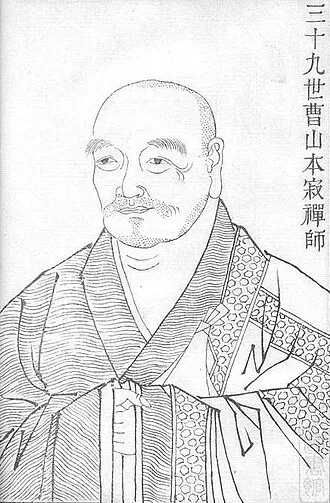
Caoshan Benji
840 – 901
Caoshan Benji (曹山本寂, 840–901) was the principal Dharma heir of Dongshan Liangjie and traditionally treated as the co-founder of the Caodong (曹洞) school, the name combining the syllable 曹 of Caoshan's mountain (Mount Cao, in modern Jiangxi) with the 洞 of his teacher Dongshan[1]. The order in which the two syllables are joined — student before teacher — is unusual; commentators since the Song have explained it as a euphonic choice, and modern scholars note that 曹 may also evoke Caoxi (曹溪), the mountain of the Sixth Patriarch Huineng, anchoring the school's claim of descent from him[2].
Caoshan's chief contribution was the systematisation of Dongshan's "Five Ranks" (五位) — the dialectical scheme describing the interplay of the absolute (zheng 正) and the relative (pian 偏) — into a more elaborate analytic framework set out in his recorded sayings and surviving in the *Caoshan Benji Chanshi Yulu*; the *Lord-and-Vassal* variant (Wuwei Junchen) and the I Ching correlations are specifically Caoshan refinements rather than direct Dongshan formulations[3]. His mountain attracted a large following during the late ninth century, but his own line did not last beyond his immediate disciples and was extinct by the mid-tenth century — *not* absorbed into Yunju Daoying's branch, which was a parallel sibling line under Dongshan that survived independently and is the conduit through which all later Caodong / Sōtō transmission, including Dōgen's, in fact runs[4]. The school as a whole nevertheless continued to bear Caoshan's name, and modern Sōtō historiography treats him as co-equal with Dongshan in the school's founding even though the surviving transmission runs through his dharma brother[4].
Names
Teachers and lineage of Caoshan Benji
Teacher / root master:
Teachings
A monk asked Caoshan, 'How is it when the absolute is within the relative?' Caoshan said, 'Like a lotus flower in the midst of fire.' The monk asked, 'How is it when the relative is within the absolute?' Caoshan said, 'Nothing in the entire universe is hidden.' The monk asked, 'How is it when absolute and relative arrive together?' Caoshan said, 'No one in the whole city of Changan.' The monk asked, 'What is their mutual integration?' Caoshan said, 'Sitting alone on the great peak.'
The absolute and the relative are like two mirrors facing each other—within each, the other is perfectly reflected. The absolute is not something remote, hidden behind the world of appearances. It is the very substance of every appearance. And the world of form is not an illusion to be discarded—it is the absolute expressing itself in ten thousand ways. To cling to the absolute and reject the world is to fall into emptiness. To cling to the world and ignore the absolute is to drown in form. The Way of our school is to walk freely between them, neither grasping nor rejecting.
- proverbWine of Jade
There is a wine of jade in this house — invisible, scentless, intoxicating. The student who reaches for the cup misses it; the student who simply sits at the table is already drinking.
- proverbLoyal Vassal
A loyal vassal speaks bluntly, even to the lord. So a real student answers his master plainly — the loyalty is in the bluntness, not in the bow.
- proverbPainting the Five Positions
I drew circles for the five positions, partly black, partly white. A picture is only paint; the positions are in the way you stand up from the cushion.
- proverbBlind Donkey
Beware of being a blind donkey, dragged by the lead. The lead is your own habit, dressed up as the dharma. Cut it, and the road is yours.
Other masters in Caodong
Master Record Sources
840-901
Caoshan Benji
Caodong
- koan_refsChart of the Chan Ancestors
52,73 10 30
840-901
Caoshan Benji
Caodong/Soto
Dongshan Liangjie
840-901
Caoshan Benji
Caodong
Dongshan Liangjie
840–901
Caoshan Benji
Caodong
- teachersWikipedia - Zen Lineage Charts
Dongshan Liangjie