Yamamoto Gempo
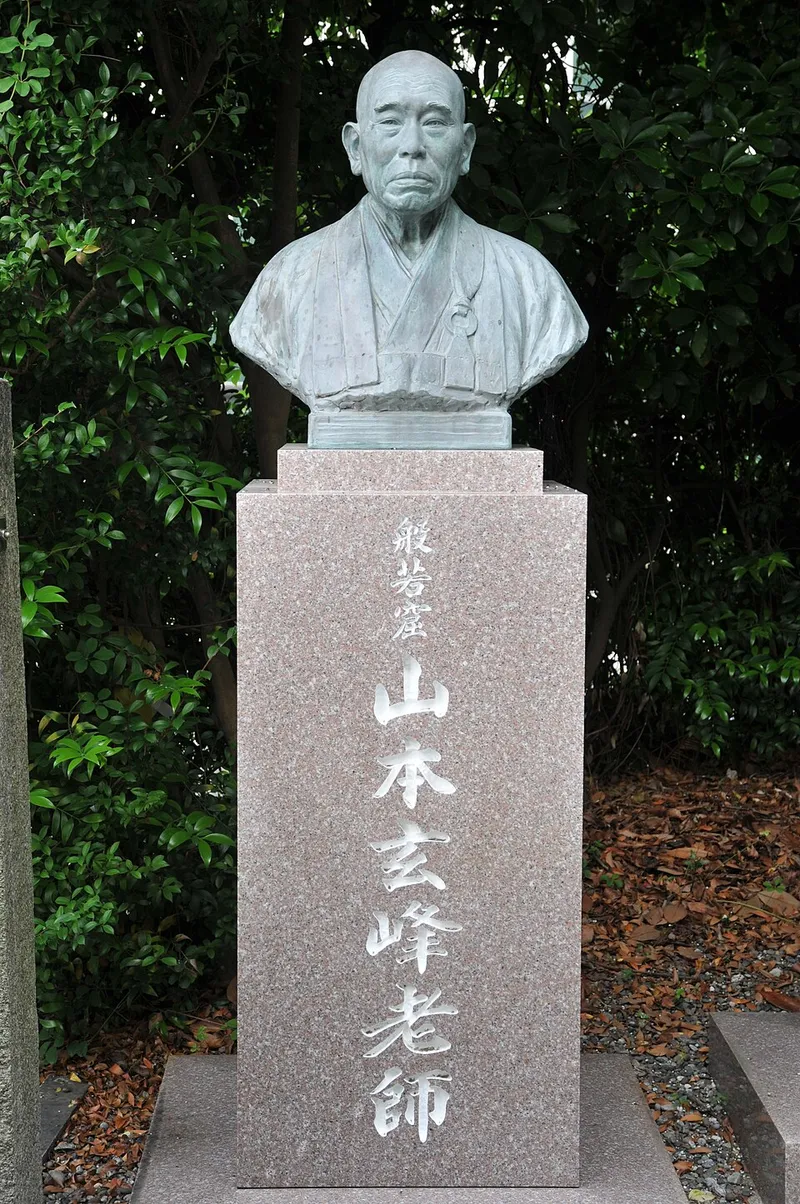
Yamamoto Gempo
1866 – 1961
Yamamoto Gempō (山本玄峰, 1866–1961) was one of the most influential Rinzai masters of twentieth-century Japan and a key figure in the postwar revival of Hakuin's Myōshin-ji line. Born in 1866 in Wakayama Prefecture, he came to the Dharma late and from extreme disadvantage: he had no formal schooling, was deemed legally blind, and learned to read and write only as an adult, taking ordination as a Rinzai monk at the age of twenty-five and then walking on pilgrimage from temple to temple across Japan[1].
Gempō eventually settled in the orbit of Hakuin's old training temple Ryūtaku-ji in Mishima, Shizuoka — a monastery that Hakuin Ekaku had relocated there in 1761 but which "had all but failed into ruins by the Taisho period, until revived by the efforts of Gempō Yamamoto"[2]. He served as abbot of both Ryūtaku-ji and Hakuin's home temple Shōin-ji, and for a period acted as head of the Myōshin-ji branch of Rinzai Zen, the largest of the Rinzai sub-schools[1]. His prodigious zenga (Zen painting) and Inuyama-ware ceramics circulated widely, and his contemporaries took to calling him "the twentieth-century Hakuin," seeing him as the closest living embodiment of Hakuin's koan curriculum and ferocious style[1].
Gempō's most consequential dharma heir was Soen Nakagawa, who first encountered him in 1935 at Hakusan Dojo while looking for a kyosaku; Gempō told the young monk, "If you practice zazen, it must be true practice," and Soen immediately requested dokusan and asked to train under him at Ryūtaku-ji[3]. When Gempō decided to retire as abbot in 1950, he insisted Soen succeed him, and Soen, though hesitant, took the seat at Ryūtaku-ji in 1951[3]. Through Soen — and through Soen's own student Eido Tai Shimano, who came to Ryūtaku-ji in 1954 — Gempō's line reached the United States, seeding the Zen Studies Society in New York and Dai Bosatsu Zendo in the Catskills. A second heir, Nakajima Genjo, continued his teaching inside Japan[1]. Gempō also publicly intervened in Japanese political life, testifying in 1934 in defense of his disciple Nisshō Inoue during the League of Blood assassination trial and remaining close to Inoue until Inoue's death the same year Gempō himself died[1]. He passed away in 1961 at ninety-four, leaving Ryūtaku-ji not only physically restored but established as one of the principal Rinzai monasteries through which postwar Western practitioners encountered Japanese Zen.
Names
Disciples of Yamamoto Gempo
Teachers and lineage of Yamamoto Gempo
Teacher / root master:
Teachings
- proverbBlind Eyes See
I went blind young, and the world arrived through other senses. The dharma was not less for it — perhaps more, since I could no longer be distracted by the appearance of the dharma.
- proverbBow to the Condemned
When asked to certify the death-sentence document, I refused. I bow to a man who is about to die; I do not certify his end. The bow was the dharma; the certificate would have been the law.
- proverbSurvival of Rinzai
After the war, when temples were reduced to ashes, the dharma was reduced to its essentials. We rebuilt smaller buildings around the same emptiness, and the practice was unbroken.
Other masters in Rinzai
Master Record Sources
- datesZen Editorial Overlay - Originals Curation
1866-1961
- nameZen Editorial Overlay - Originals Curation
Yamamoto Gempo
- schoolZen Editorial Overlay - Originals Curation
Rinzai
- teachersZen Editorial Overlay - Originals Curation
Sohan Genyo