Etienne Mokusho Zeisler
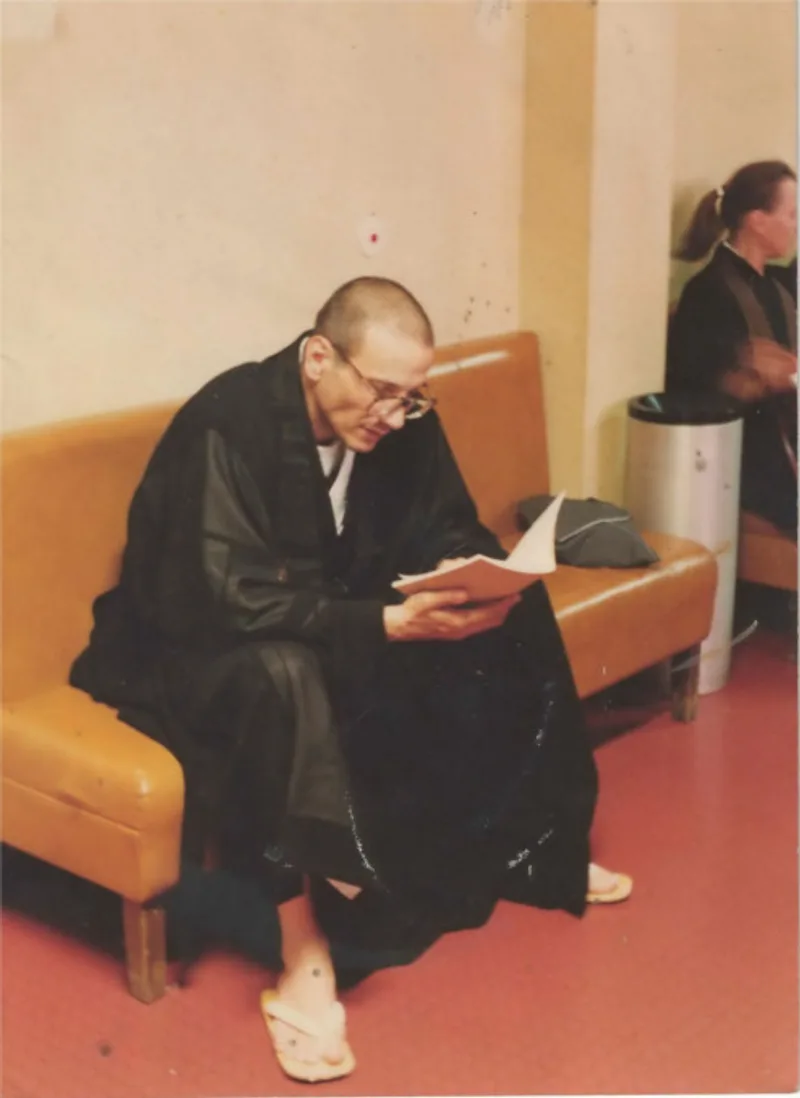
Etienne Mokusho Zeisler
1946 – 1990
Étienne Mokushō Zeisler (1946 – 7 June 1990) was a Hungarian-French Sōtō Zen monk and one of Taisen Deshimaru's three principal dharma heirs. He met Deshimaru in the years following the latter's 1967 arrival in Paris, was ordained as a monk, and became one of his closest disciples, working alongside the master at the founding generation of European Sōtō dōjōs. **In 1984, two years after Deshimaru's death, Niwa Rempō Zenji — abbot of Eihei-ji and the highest authority of Japanese Sōtō Zen — conferred dharma transmission (shihō) on Zeisler together with Stéphane Kōsen Thibaut and Roland Yuno Rech**, formally authenticating Deshimaru's mission in Europe[1].
Zeisler's distinctive contribution was geographical. From the late 1980s he turned his teaching east, undertaking missionary trips into Romania, Hungary, and what was then Czechoslovakia at a time when Western Buddhist practice was almost unknown behind the Iron Curtain[3]. He died on 7 June 1990 at the age of 44, leaving the mission to extend Deshimaru's lineage into the post-communist East to his dharma-heir, the monk Yvon Myōken Bec, who founded **Mokusho Zen House Budapest in 1992** — the first sustained Sōtō Zen sangha in Hungary, named in Zeisler's memory[2]. Through Myōken's later transmission from Kōsen Thibaut the Zeisler line is today carried forward in Hungary, Romania, and the broader Eastern European Buddhist landscape, and the Mokusho Zen House network has trained Vincent Keisen Vuillemin (Geneva) and others as direct disciples of Zeisler's[2].
The institutional shape of the post-Zeisler mission can be reconstructed in detail from the Mokushō Zen House lineage record. Bec's first Romanian trips began in 1991, and the very first Eastern European Zen dōjō was founded in Bucharest in 1993; the Mokushō Zen Ház at Uszó, together with the Zeisler Foundation, followed in 1994; the first Hungarian urban dōjō opened in Budapest's Ilka street in 1995; the network's mountain temple Hōbō-ji was built in the sacred Pilis range in 1997; and the Hungarian sangha consolidated at the Taisen-ji temple in Budapest in 2000[4]. Bec himself received shihō from Kōsen Thibaut in 2002, and in 2015 the Sōtō school posthumously conferred on Zeisler the honorific title **Sōbo (祖母, "Treasure of the Sangha")**, a Japanese institutional recognition of the magnitude of his Eastern European mission[4].
A second generation of formally transmitted teachers now carries the line. **In 2007 Bec conferred shihō on Vincent Keisen Vuillemin** of Geneva — Zeisler's direct Francophone Swiss disciple — and **in 2016 he transmitted to three further successors in the Deshimaru–Zeisler lineage: Maria Teresa Shōgetsu Avila (Geneva, with extension to Senkuji in the Ecuadorian Amazon, opened 2018–19), Ionuț Koshin Nedelcu (abbot of Mokushōzenji, Bucharest), and László Toryu Kálmán (Sümegi Mokushō Zen Dōjō, Hungary)**[4][5]. Together these four shihō recipients are the formal continuing teachers of the Mokushō Zen House network and the institutional answer to the question Zeisler's early death had left open: who would carry his mission past the founder's generation[4].
Zeisler's place in the AZI lineage is not as a long-living institution-builder but as the disciple who, more than any other, redirected Deshimaru's western mission eastward across the Cold-War divide before his early death — a redirection whose institutional fruit, three and a half decades on, is the four-temple Mokushō Zen House network and its formal continuing teachers in Geneva, Bucharest, Budapest, and the Ecuadorian Amazon[4].
Names
Disciples of Etienne Mokusho Zeisler
Teachers and lineage of Etienne Mokusho Zeisler
Teacher / root master:
Formal Dharma transmission (shihō):
Other masters in Sōtō
Master Record Sources
1946-1990
Etienne Mokusho Zeisler
Soto
Taisen Deshimaru