Taisen Deshimaru
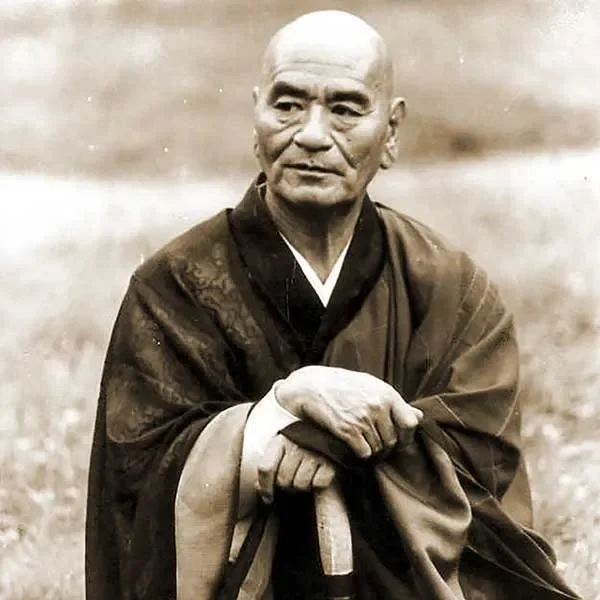
Taisen Deshimaru
1914 – 1982
Mokudō Taisen Deshimaru (弟子丸泰仙, 1914–1982) was a Japanese Sōtō Zen monk and the principal figure in the establishment of European Sōtō Zen. Born in Saga Prefecture in southern Kyūshū to a Jōdo Shinshū household with samurai antecedents, he encountered the itinerant Sōtō teacher Kōdō Sawaki in the 1930s and remained Sawaki's lay disciple for the next three decades while working as a businessman in Tokyo and Kobe[1][2]. His attachment to Sawaki's signature teaching — zazen practised without object and without expectation of gain — shaped every later phase of his life and the tradition he transplanted to Europe[2].
During the Second World War Deshimaru was sent to the Indonesian island of Bangka to administer a copper mine for the Japanese occupation; according to the AZI's institutional history he refused repatriation at the war's end so as to remain with the local population and was interned by Allied forces before being returned to Japan[3]. He resumed lay practice with Sawaki in the postwar years and, only weeks before Sawaki's death in December 1965, received monastic ordination from him together with the instruction that became the seed of his European mission: to take Sōtō zazen to the West[1][3].
In 1967 Deshimaru travelled to Paris on a one-way ticket and began teaching zazen in borrowed rooms above a Parisian macrobiotic shop, attracting a small group of French disciples who soon constituted the first European Sōtō sangha[3][4]. He founded the Association Zen Internationale (AZI) in 1970 to coordinate the rapidly multiplying dōjōs and, in 1979, acquired the Château de La Gendronnière in the Loire Valley as the AZI's residential temple — by the time of his death the AZI network spanned over a hundred dōjōs and practice groups across Western Europe[4]. He received Dharma transmission (shihō) from Yamada Reirin in 1970 and was later named kaikyōsōkan, the Sōtōshū's official representative for Europe, formalising the link between his European sangha and the Japanese Sōtō headquarters[1].
Deshimaru's teaching pivoted on three terms drawn from Dōgen and Sawaki and made central to AZI practice: shikantaza ("just sitting") as the sole essential discipline, mushotoku as the correct attitude of practice without gaining mind, and hishiryo as the quality of awareness in zazen — "thinking from the depth of non-thinking"[5]. His primary medium was kusen, oral teachings delivered in the dōjō during zazen itself, transcribed and edited by close disciples to produce the substantial French-language bibliography that introduced Zen to a generation of European readers[5]. He returned to Japan in early 1982 with terminal cancer and died there in April of that year, aged sixty-seven[1].
His Dharma was carried forward by a generation of European successors — Étienne Mokushō Zeisler, Roland Yuno Rech, Stéphane Kosen Thibaut, Philippe Reiryū Coupey, Évelyne Ekō de Smedt, Pierre Reigen Crépon, Olivier Reigen Wang-Genh, Jean-Pierre Genshū Faure, Vincent Keisen Vuillemin, and others — who continued the AZI lineage from temples and dōjōs across France, Switzerland, Spain, Portugal, Germany, and beyond, and through whom most of his oral teachings reached print[6][4].
Names
Teachers and lineage of Taisen Deshimaru
Teacher / root master:
Formal Dharma transmission (shihō):
Works
- Zen et Arts MartiauxThe Zen Way to the Martial Arts (Zen et Arts Martiaux)
Deshimaru's most widely read book in English: a sustained meditation, originally published in French in 1977 as Zen et Arts Martiaux, on the shared root of zazen and bushidō. Drawing on his Saga upbringing and on kendō and judō practice with his European students, he frames the martial arts as a particular case of mushotoku attention — concentration without goal, action without ego — and uses them to explicate posture, breathing, and the quality of mind he called hishiryo. The standard introductory volume to his teaching for non-French readers.
- Questions à un maître zenQuestions to a Zen Master (Questions à un maître zen)
A book-length transcript of Deshimaru's mondō — the question-and-answer sessions held after zazen at the Paris dōjō and at sesshin across Europe. Originally published as Questions à un maître zen (Pierre Belfond, 1981) and translated into English by Nancy Amphoux for E. P. Dutton in 1985, it preserves the unedited interrogative texture of his teaching: students asking about karma, sex, money, fear of death, and the nature of mind, and Deshimaru responding in compact, idiomatic French. One of the most accessible primary sources for his oral style.
- The Voice of the ValleyThe Voice of the Valley: Zen Teachings
An English-language compilation of Deshimaru's kusen prepared by his American disciple Philippe Reiryū Coupey, drawing on the dōjō transcripts of the late 1970s. The volume's title alludes to Dōgen's keisei sanshoku ("valley sounds, mountain colours") and frames Deshimaru's instruction as a contemporary continuation of the Sōtō tradition's attention to ordinary perception. Read alongside Sit and Mushotoku Mind, it is the principal English access point to his kusen.
- L'Anneau de la VoieThe Ring of the Way (L'Anneau de la Voie)
A late-period volume co-authored with Évelyne Ekō de Smedt, in which Deshimaru comments verse-by-verse on classical Sōtō texts (the Hannya Shingyō, the Sandōkai, fragments of the Shōbōgenzō) interleaved with first-person reflection on practice and lineage. Published in French in 1982, the year of his death, and translated into English in 1983, it is the most explicit statement of his understanding of the transmission line he was inserting Europe into.
A posthumous English-language anthology of Deshimaru's kusen, edited by Philippe Reiryū Coupey at the Paris dōjō from transcripts of zazen sessions held at the AZI in the late 1970s and early 1980s. The book is organised around fundamental Sōtō themes — the posture, breath, the bodhisattva precepts, the relation of zazen to ordinary life — and is widely used as the introductory English text in Deshimaru-line dōjōs.
- Mushotoku MindMushotoku Mind: The Heart of the Heart Sutra
A book-length kusen-commentary on the Hannya Shingyō (Heart Sutra), assembled by Philippe Reiryū Coupey from Deshimaru's oral teachings at the Paris dōjō. The volume threads Deshimaru's signature term — mushotoku, the mind without gaining idea — through the sutra's negation formulas ("no eye, no ear, no nose…"), reading the Heart Sutra not as a metaphysical thesis but as the description of the consciousness that arises in shikantaza.
Deshimaru's running French commentary on Dōgen's Shōbōgenzō, transcribed from teisho given at La Gendronnière. The volume is the closest he came to producing a sustained doctrinal exposition rather than situational kusen, and it shows him reading Dōgen line-by-line in French for an audience that had no access to the Japanese original. A central reference for the AZI's understanding of its Sōtō pedigree.
- Le Bol et le BâtonLe Bol et le Bâton: 120 contes zen
A posthumous collection of one hundred and twenty classical Zen tales as told and commented on by Deshimaru in the dōjō, prepared from kusen transcripts. The cases run from the Tang encounter dialogues through Dōgen's Shōbōgenzō anecdotes, each followed by Deshimaru's compact French commentary. Functions as the AZI's working koan-anthology in the absence of a formal Rinzai-style curriculum.
- Dharma teachingThe Zen Way to the Martial Arts
Deshimaru's most-translated book; develops the relationship between zazen, the bushidō tradition, and the somatic discipline of the Japanese martial arts. Originally published in French as *Zen et arts martiaux* (Seghers, 1977).
- Dharma teaching (French)La pratique du Zen
The most accessible French-language introduction to zazen as taught by Deshimaru — drawn from his Paris dōjō teisho of the 1970s.
- Dharma teachingMushotoku Mind
Posthumous English-language collection of Deshimaru's teisho on the Hokyo Zanmai, transcribed and edited by Philippe Reiryū Coupey.
- Dharma teachingQuestions to a Zen Master
Question-and-answer format collection drawn from Deshimaru's Paris dōjō sessions; the format that most preserves his characteristic spoken voice in English translation.
- Institutional siteAssociation Zen Internationale — zen-azi.org
The official site of the Association Zen Internationale, the federation Deshimaru founded in Paris in 1970; carries the dōjō directory, teaching schedule, and a substantial archive of Deshimaru's teisho transcripts.
Teachings
- proverbJust Sit
You must simply sit. Do not think. Do not try to become Buddha. Just sit. Only sit.
- proverbThe Cosmos in the Posture
When you sit in zazen, you are the whole cosmos sitting. There is nothing outside of this posture.
- proverbAutomatic Thinking
During zazen, thoughts come automatically. Let them come, let them go. Do not run after them. Do not run away from them. This is the secret.
- proverbObserve Your Own Mind
You do not need to search for the truth. You only need to observe your own mind.
True zazen is practiced without any object, without seeking any result, without any goal—mushotoku. If you practice zazen to gain something, it is no longer zazen. Sit simply, concentrate on the posture, breathe naturally, and let thoughts pass like clouds in the sky. This is the highest form of practice. There is nothing to achieve because you already have everything from the beginning.
During zazen, do not try to stop your thoughts. Do not try to chase them away. And do not follow them either. Let them come, let them go. This is the secret of Zen: hishiryo, beyond thinking. It is not thinking, it is not not-thinking. It is the consciousness before thought arises, the consciousness that is the source of all thought. When you return to this consciousness, even for a single breath, you touch the essence of Buddha.
Concentrate on the posture. Push the earth with the knees, push the sky with the top of the head. The chin is pulled in, the nape of the neck stretched, the nose vertical above the navel. The hands are in the cosmic mudra, left hand on right, thumbs touching horizontally. Do not lean to the left or the right, forward or backward. The posture of zazen is not the means to awakening—it is awakening itself. The body and mind are not two. When the body takes the posture of Buddha, the mind becomes the mind of Buddha.
- sayingTrue Zen Is Useless
True Zen is useless. It does not serve any purpose. It is not useful for business, for health, for success. In our civilization, people want everything to be useful—they cannot understand something that has no utility. But the highest things in life are useless: love, art, poetry, contemplation. Zazen is the most useless thing, and therefore the most precious.
- sayingHere, Now, Nothing Else
You must concentrate on zazen. Only zazen. Here, now, nothing else. Not the zazen of yesterday, not the zazen of tomorrow. This zazen, this breath, this posture. If you can truly be here, completely, for just one moment—that is satori.
- sermonShikantaza: Only Sit
Shikantaza means only sit. Not sit and pray, not sit and concentrate on a mantra, not sit and try to understand a koan. Only sit. The body sits, the breath comes and goes, and that is enough. Dōgen said zazen itself is enlightenment—not the cause, not the means, but enlightenment as it actually appears. When you sit shikantaza, the Buddhas of all directions sit with you. There is no second step.
In zazen, two sicknesses arise. Kontin: drowsiness, dullness, the mind sinking into a soft cloud. Sanran: agitation, the mind running after thoughts like a dog after a bone. Most beginners alternate between the two. The remedy is the same for both: come back to the posture. Push the earth with the knees. Push the sky with the head. Stretch the spine. The breath becomes long and quiet, the eyes open, the gaze drops to the floor in front of you. Then the mind clarifies on its own. You do not fight kontin or sanran—you let the posture cure them.
In the West, you cut the body from the mind. The mind is up here, in the head, and the body is something the mind drags around. This is your great suffering. In zazen, you discover shinjin ichinyo: body and mind are one. The posture of the body is already the posture of the mind. When the spine is straight, the thought is straight. When the breath is deep, the consciousness is deep. There is no inner work to do separately—just take the right posture, and the rest follows.
The samurai who hesitates is already dead. The swordsman who calculates—"if I strike here, my opponent will move there"—loses the contest before it begins. True bushido is the same as true zen: act without ego, decide without calculation, give yourself entirely to the present moment. The sword cuts because the body cuts; the body cuts because the mind is mushotoku, without aim. Zazen is the deepest training of the warrior, and the warrior's discipline is the most concrete expression of zazen.
Zen is not complicated. Eat when you are hungry. Sleep when you are tired. Sit zazen when it is time to sit. The whole difficulty is that we do not do these simple things—we eat without tasting, sleep without resting, sit without sitting. To return to the simplest action, completely, is the entire teaching. The most ordinary life, lived attentively, is already the life of a Buddha.
- proverbMushotoku — Without Goal
Sit without goal — mushotoku. The student who sits to attain has already left the cushion. Drop the goal, and the cushion attains the student.
- proverbHere and Now
The dojo is here, the cushion is here, the breath is here. There is no Japan, no robe, no master that is not also here. Practice in the place you are.
- proverbBack Straight, Mind Loose
Stretch the spine; loosen the mind. The spine is the discipline of the body; the loose mind is the discipline of the discipline. Both belong to the same Zen.
The way of the warrior and the way of Zen meet on the same cushion. Both ask you to drop the fear of dying. The warrior drops it for one battle; the Zen student drops it for every breath.
Other masters in Sōtō
Master Record Sources
1914-1982
Taisen Deshimaru
Soto
Kodo Sawaki