Kosho Uchiyama
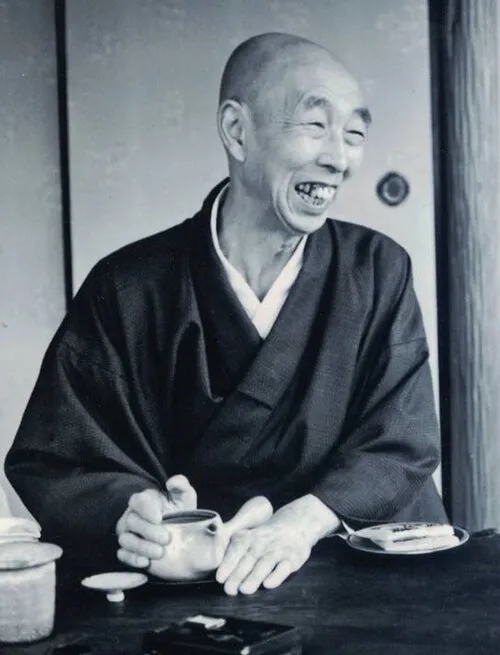
Kosho Uchiyama
1912 – 1998
Kōshō Uchiyama (1912–March 13, 1998) was a Sōtō Zen priest, prolific essayist, and origami master whose decade as abbot of Antai-ji (1965–1975) shaped a distinctive lay-and-monastic Zen rooted in pure zazen and self-supporting begging[1]. Born in Tokyo, he earned an M.A. in Western philosophy from Waseda University in 1937, then sought ordination after the death of his first wife; he was ordained in 1941 by Kōdō Sawaki, the itinerant "Homeless Kōdō" whose anti-institutional Zen would mark Uchiyama's entire teaching life[1]. He spent the war and postwar years living in extreme poverty alongside Sawaki at Antai-ji in Kyoto's Gentaku district, struggling continuously with the long-term effects of tuberculosis[1].
When Sawaki was installed as Antai-ji's fifth abbot in 1949 he made the temple "a place for zazen," but because he traveled constantly, his student Uchiyama managed most temple responsibilities; Sawaki only relocated permanently in 1962 once mobility failed him[2]. After Sawaki's death in 1965 Uchiyama became the sixth abbot, and under his leadership Antai-ji became known for "devoted practice of zazen and formal begging," refusing the funeral economy of conventional Japanese temples and surviving "completely on donations from lay practitioners and begging"[2]. He retired in 1975 to Nokei-in near Kyoto, where he continued writing and receiving students until his death; the monastery itself was relocated to rural northern Hyōgo in 1976 to escape urban encroachment[2].
Uchiyama wrote more than twenty books on Zen and on origami. The works most widely read in English are *Refining Your Life: From the Zen Kitchen to Enlightenment* (Weatherhill, 1983), his commentary on Dōgen's *Tenzo Kyōkun*, reissued as *How to Cook Your Life* (Shambhala, 2005); *Opening the Hand of Thought: Foundations of Zen Buddhist Practice* (Penguin, 1993; revised Wisdom, 2004); and *The Wholehearted Way: A Translation of Eihei Dōgen's Bendōwa with Commentary* (Tuttle, 1997, with Shōhaku Okumura)[1]. His framework of "one zazen, two practices, three minds" — practice as vow and repentance, lived through magnanimous, nurturing, and joyful mind — became the operating manual for a generation of Western Sōtō teachers[1]. Among his Dharma heirs the most influential abroad is Shōhaku Okumura, founder of Sanshin Zen Community in Indiana and the principal translator of Uchiyama and Dōgen into English[1][2].
Names
Teachers and lineage of Kosho Uchiyama
Teacher / root master:
Other masters in Sōtō
Master Record Sources
1912-1998
Kosho Uchiyama
Soto
Kodo Sawaki