Kodo Sawaki
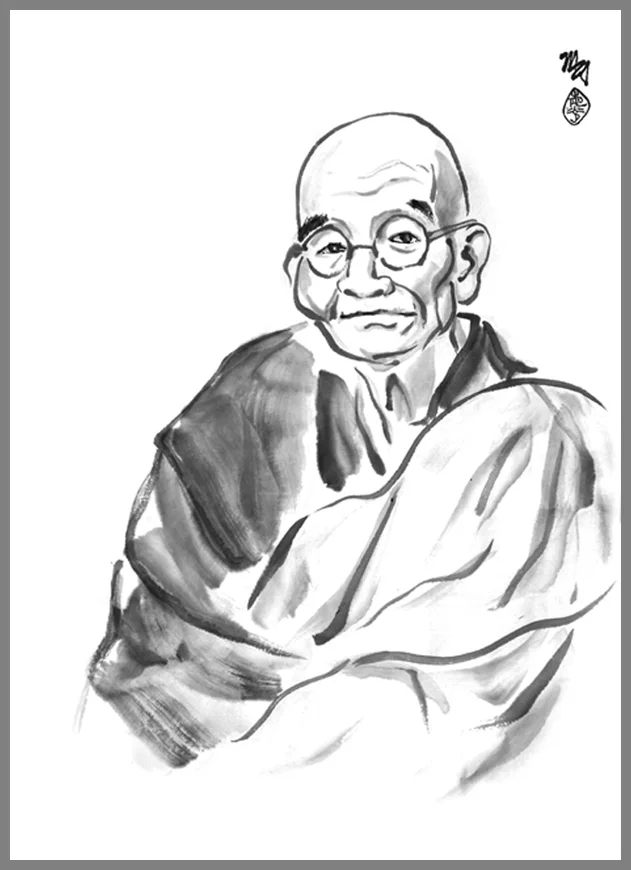
Kodo Sawaki
1880 – 1965
Kōdō Sawaki (澤木 興道, 1880–1965), known throughout Japan as "Homeless Kōdō" (Yadonashi Kōdō), was the modern Sōtō master most responsible for severing the practice of zazen from the temple-funeral economy and restoring shikantaza as the living center of the school. He was born June 16, 1880 in Tsu, Mie Prefecture; orphaned by age seven, he was taken in by a lantern-maker named Bunkichi Sawaki whose home doubled as a gambling parlor — an upbringing he later credited with immunizing him against any romance about respectability[1]. At sixteen he ran away to Eihei-ji, found work as a temple servant, and at eighteen entered Sōshin-ji, where he was ordained in 1899 by Kōhō Sawada and received dharma transmission from Zenkō Sawada in 1906[1].
He served in the Russo-Japanese War (1904–1905) — shot through the neck, the bullet splitting his tongue — and afterward returned to formal study, eventually holding a professorship in Buddhist studies at Komazawa University from the 1930s. In 1949 he assumed responsibility for Antai-ji in Kyoto, but never settled there: he refused a fixed abbacy, declined to perform funerals for income, and instead spent decades on the road leading sesshin at temples, factories, prisons, and universities across Japan, hence the epithet "Homeless Kōdō"[1]. His teaching was austere and unsentimental — zazen, he insisted, "is good for nothing"; it is not a means to enlightenment, social benefit, or temple revenue, but the direct expression of the Buddha's awakening[1].
Sawaki wrote relatively little himself; his teaching was preserved by students and editors. The most important compilations are *The Zen Teaching of Homeless Kōdō* (Wisdom Publications, 2014), assembled by his successor Kōshō Uchiyama and translated by Shōhaku Okumura; the *To You* (*Anata ni*) series of thirty-four direct addresses, also compiled by Uchiyama; and *Commentary on the Song of Awakening* (Merwin Asia, 2014), his teisho on Yōka Daishi's *Shōdōka*[1]. His named dharma heirs include Kōshō Uchiyama (1912–1998), who succeeded him at Antai-ji and authored *Opening the Hand of Thought*; Shūyū Narita (1914–2004); Sodō Yokoyama (1907–1980), the "leaf-flute philosopher"; and Kōjun Kishigami (b. 1941), now teaching in France. Major students who carried the line abroad without formal transmission from Sawaki himself include Taisen Deshimaru (1914–1982), who founded the Association Zen Internationale in France; Kōbun Chino Otogawa (1938–2002), influential in the American West; and Gudō Wafu Nishijima (1919–2014)[1]. Sawaki died at Antai-ji on December 21, 1965; his last words — "Nature is magnificent" — are widely quoted in his lineage[1].
Names
Disciples of Kodo Sawaki
Teachers and lineage of Kodo Sawaki
Teacher / root master:
Teachings
- proverbLost in Thought
You are all lost in thought, twenty-four hours a day. Zazen means waking up from that dream.
- proverbSatori Is Not a Commodity
Satori is not a commodity you can acquire. Zazen that doesn't aim at satori—that is the real thing.
- proverbSit Down and Shut Up
Sit down and shut up. That is zazen. Everything else is just your imagination running wild.
- proverbZazen Is the Self
Zazen is the self making the self into the self.
Zazen is good for nothing. Until you understand this, zazen won't work for you. As long as you sit with some purpose, some goal, some expectation, you are not doing zazen. True zazen is sitting with no gaining idea whatsoever.
- sayingYou Can't Trade a Fart
You can't even trade a single fart with the next guy. Each and every one of us has to live out our own life. Don't waste time trying to be someone else.
- sayingGaining Is Delusion
Gaining is delusion. Losing is enlightenment.
Hell is not somewhere else. The scenery of hell exists right in the middle of our own chest.
- sayingGroup Sickness
What is the world? It is group sickness. Everyone is crazy, so nobody notices the craziness. When everyone is deluded together, the delusion seems normal. Zazen means waking up from this group sickness and walking on your own two feet.
What is religion? It is living your own life, completely fresh and new, without being taken in by anyone.
People always put their heads together and try to figure things out. But no matter how many deluded people put their heads together, all they'll come up with is delusion. One person sitting zazen is worth more than a million people discussing Zen.
- sayingThere Is No One to Be
You're all running around trying to become something, trying to be somebody. But there's no one to become. You're already who you are. The problem is that who you are doesn't match up with who you think you should be. Sit zazen and give up trying to be somebody.
- sayingThoughts Are a Secretion
Thinking is just a secretion of the brain, the same way the stomach secretes digestive juices. You don't have to take it so seriously. Let your thoughts come and go during zazen. Don't chase them, don't fight them. They're just brain secretions.
The self that lives your whole life is not the self that society has created. Society made you a name, a position, a reputation. But the self that sits zazen, that breathes, that dies—this self was never born and can never die. This is your original face before your parents were born.
- sayingJust Sit
When you sit zazen, just sit. Don't sit in order to become a Buddha. Don't sit in order to get enlightened. Don't sit in order to feel good. Don't sit for any reason at all. Just sit. That's it. That's the whole thing.
- sayingEveryone Wants Happiness
Everyone is running around trying to find happiness. But the happiness they find is only suffering in disguise. True happiness has nothing to do with pleasure. True happiness is when you stop running.
- sayingZen Is Everyday Life
Zen is not some kind of excitement, but concentration on our usual everyday routine. Sweeping the garden, wiping the floor, cooking the food—this is Zen practice. Don't look for it somewhere special.
Other masters in Sōtō
Master Record Sources
1880-1965
Kodo Sawaki
Soto
Sawada Zenko