Vasubandhu
Vasubandhu
c. 316 – c. 396
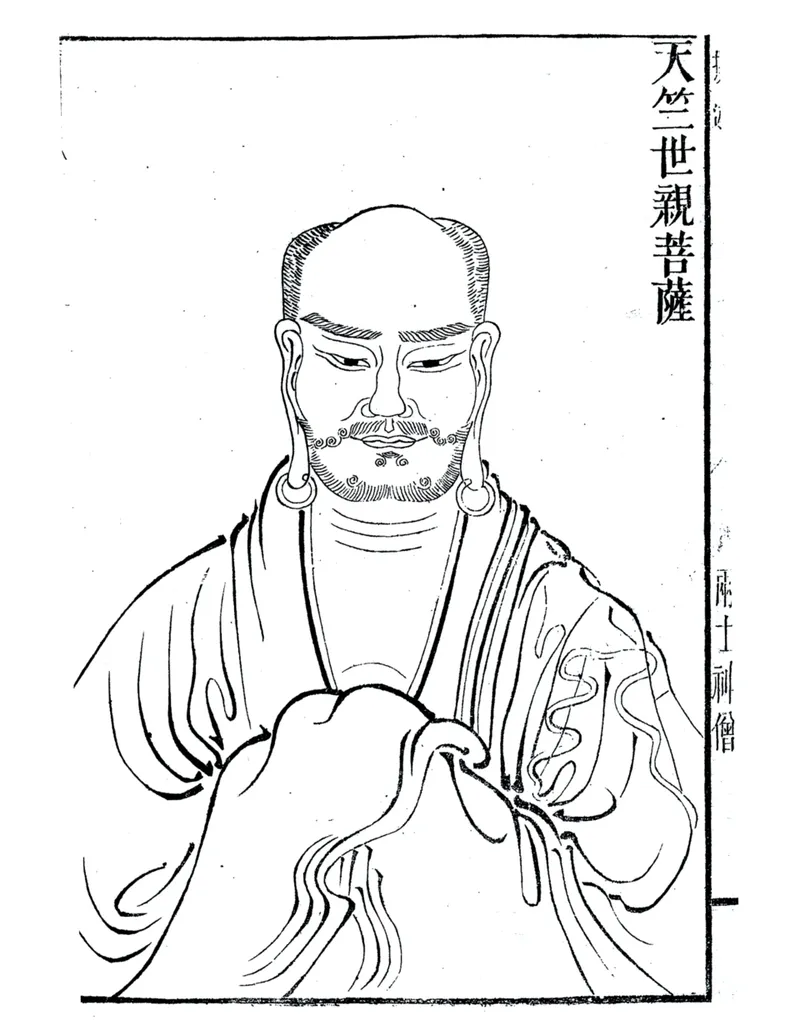
The figure named as the twenty-first Chan patriarch presents a famously difficult identification problem[1]. The Sanskrit name Vasubandhu in Indian Buddhist history attaches most prominently to the great Yogācāra philosopher of the fourth–fifth century CE, brother and disciple of Asaṅga, author of the *Abhidharmakośa*, the *Triṃśikā* (Thirty Verses), the *Viṃśatikā* (Twenty Verses), and the foundational treatises of the Yogācāra ("Mind-Only") school[2]. The Chan tradition's twenty-first patriarch, however, is dated to a period earlier than the Yogācāra Vasubandhu and described as the disciple of Jayata and teacher of Manorhita, suggesting a different—or, more likely, composite—figure.
The historical Vasubandhu, on the chronology proposed by Erich Frauwallner and now widely discussed in scholarship, may in fact be two distinct figures of the same name conflated by the later tradition: a fourth-century Vasubandhu, brother of Asaṅga and author of the Yogācāra trilogy, and a fifth-century Vasubandhu who composed the *Abhidharmakośa*[3]. Whether the Chan patriarch corresponds to either of these or to a still earlier teacher cannot be determined from the surviving sources.
What is certain is that the historical Vasubandhu's *vijñaptimātratā* ("nothing-but-cognition") doctrine had a profound effect on Chinese Mahāyāna and indirectly on Chan. The *Triṃśikā* analyzes consciousness into the *ālayavijñāna* (storehouse consciousness), the *manas* (afflicted mind), and the six sense-consciousnesses, and proposes that all phenomena are transformations of consciousness[4]. This analysis entered Chinese Buddhism through Paramārtha (6th c.) and Xuánzàng's Faxiang school (7th c.), and forms part of the philosophical background against which Chan defines its own position—at times appropriating Yogācāra categories (the *ālayavijñāna* as an analogue of original mind), at times rejecting Yogācāra's analytical mode in favor of direct pointing[5].
In the *Jǐngdé Chuándēng Lù*, the twenty-first patriarch is described in stock hagiographical terms as the converter of an army of disputants in northwestern India and the recognizer of his successor Manorhita[6]. Dumoulin notes that the placement of a "Vasubandhu" in the lineage gives the Chan transmission a connection to the prestigious Yogācāra philosophical tradition without committing the compilers to specific historical claims[7].
Names
Disciples of Vasubandhu
Teachers and lineage of Vasubandhu
Teacher / root master:
Teachings
All that we experience is nothing but consciousness. What appears as an external world is the transformation of consciousness itself. There are three natures to be understood: the imagined nature, which is the false construction of self and dharmas where none exist; the dependent nature, which is the arising of consciousness through causes and conditions; and the perfected nature, which is the dependent nature free from the imagined. When the imagined is removed from the dependent, what remains is the perfected—suchness itself. This is the meaning of consciousness-only: not that nothing exists, but that nothing exists in the way we imagine it to.
Mind makes the world; the world makes the mind. Stand at the seam of these two, and the whole loom shows itself.
- proverbChanged His Mind
I taught the doctrine of one school for thirty years and then changed my mind. The students who refused to change with me lost more than I did.
- proverbStorehouse Consciousness
The seeds of all your acts are stored in a hidden room of the mind. Each act planted today is a fruit you will eat tomorrow — be careful what you sow even when no one is looking.
- proverbThree Natures
The imagined, the dependent, the perfected — three natures of one experience. The imagined hides the dependent; the dependent hides the perfected; remove the imagined, and the rest is already shining.
Other masters in Indian Patriarchs
Master Record Sources
- datesZen Editorial Overlay - Originals Curation
c. 316-396 CE
- nameZen Editorial Overlay - Originals Curation
Vasubandhu
- schoolZen Editorial Overlay - Originals Curation
Indian Patriarchs
- teachersZen Editorial Overlay - Originals Curation
Jayata
- identityWikipedia - Zen Lineage Charts
Vasubandhu (4th–5th century CE) was a prolific Abhidharma and Yogācāra scholar, co-founder of the Vijñānavāda school alongside Asaṅga; he is counted the twenty-first Indian patriarch in Chan reckoning.