Guiyang
Chan
Guiyang
潙仰宗
Branch of Nanyue line
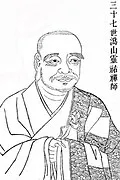
The Guiyang school (潙仰宗) was the earliest of the Five Houses of Chan to be formally recognized, founded by Guishan Lingyou (771–853) and his student Yangshan Huiji (807–883) in the lineage of Baizhang Huaihai[1][2]. The school's name combines the first characters of their respective mountains. The Guiyang school was distinguished by its refined and indirect teaching methods, particularly the use of ninety-seven circular figures (yuan-xiang) to express the relationship between the absolute and relative—a sophisticated non-verbal language that complemented the verbal exchanges used by other schools[2]. Where the Linji school employed shouts and blows, the Guiyang tradition favored subtle gestures, drawn symbols, and the interplay of 'host' and 'guest' as pedagogical tools. Key figures include Xiangyan Zhixian, who awakened at the sound of a pebble striking bamboo after burning all his scholarly notes[3], and Liu Tiemo ('Iron Grindstone Liu'), a formidable female dharma heir of Guishan whose sharp dialogues ground down all challengers. In the modern era, the Guiyang lineage was revived by the great master Xuyun (1840–1959)[4], who transmitted it to Hsuan Hua[5]. The Guiyang school did not survive as an independent institution beyond the Song dynasty, but its insights into symbolic communication and the non-verbal dimensions of transmission influenced the broader Chan tradition.
Meditation practice
The Guiyang school employed ninety-seven circular figures (yuan-xiang) as contemplative tools, using drawn forms, symbolic gestures, and subtle exchanges to express relationships that ordinary explanation cannot capture[2]. In practice encounters, master and student might work with a figure or gesture rather than a sentence, making non-verbal communication itself part of the training. This did not replace sitting meditation; it refined the practitioner’s sensitivity to how absolute and relative, host and guest, presence and response shift within a living encounter. The school’s distinctive contribution is therefore a contemplative pedagogy of symbolic form rather than blunt confrontation.
Key texts
- Guishan's Admonitions
'Guishan jingce' — the founder's pungent warnings to monks about laxity, scholarly conceit, and the waste of one's life. Still chanted and studied in Chan and Zen monasteries as a call to practice seriousness.
Key concepts
- Ninety-seven Circular Figures
Yangshan Huiji's collection of drawn circular forms used as non-verbal teaching devices — a sophisticated symbolic language that complemented the school's subtle encounter-dialogue style.
- Host and Guest
The pedagogical pair Yangshan used to analyze encounter dynamics: who meets whom as absolute (host) and who as relative (guest), and how those roles interpenetrate in the moment of exchange.
In the words of the masters
- A Painting of a Rice Cake Cannot Satisfy Hunger
A painting of a rice cake cannot satisfy hunger.
- Tile Striking the Bamboo
Sweeping the path, a piece of tile struck the bamboo. The sound emptied my whole search of thirty years; I bowed in the direction of my old master and said: had he answered me then, I would never have arrived here.
- A Man Up a Tree
A man hangs from a tree by his teeth. Hands cannot hold a branch, feet cannot reach a limb. Someone asks the meaning of the patriarch's coming from the west. If he opens his mouth, he loses his life. If he does not open it, he fails to answer. What does he do?
- Sweep the Path
Sweep the path. Sweep it again. Sweep it for thirty years. One day the broom will sweep the sweeper; and you will hear what tile-on-bamboo means without anyone striking either.
- One Blow Forgets All Previous Knowledge
One blow, and all previous knowledge is forgotten. Then there is no need for tactics or rules; the body practices on its own; the day's work is enough.
Masters in this branch
Sibling branches of Nanyue line
Sources in use
- Chart of the Chan Ancestors
- Zen Editorial Overlay - Originals Curation