Aryadeva
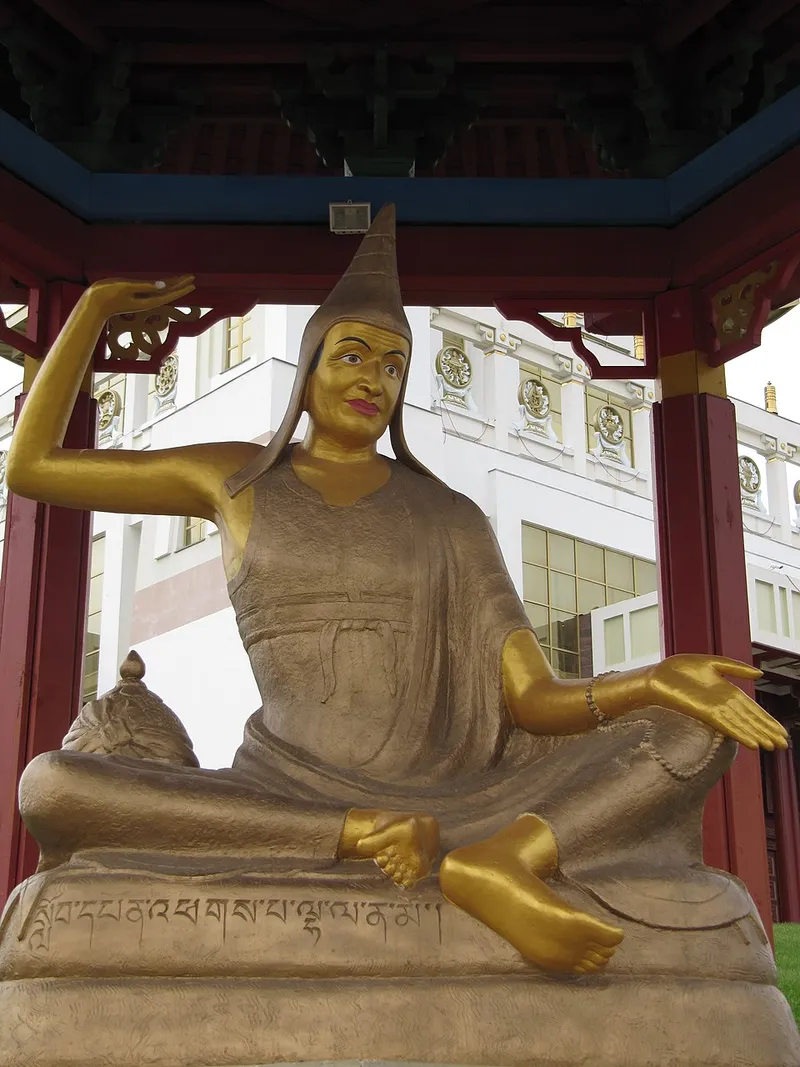
Aryadeva
c. 170 – c. 270
Āryadeva (c. 170–270 CE), counted as the fifteenth Chan patriarch, was Nāgārjuna's principal disciple and the chief expositor of Madhyamaka in the second generation[1]. He is a securely historical figure with a verifiable corpus of works preserved in Sanskrit, Chinese, and Tibetan. Tibetan tradition records that he was born in Sri Lanka or southern India, possibly to a royal family, and traveled north to study with Nāgārjuna; some accounts say he encountered his teacher at Nāgārjuna's mountain hermitage of Śrīparvata in Andhra[2].
Āryadeva's principal work is the *Catuḥśataka* (Four Hundred Verses on the Middle Way), a sixteen-chapter polemical and analytical treatise that extends the *Mūlamadhyamakakārikā* into the domains of practice, ethics, and refutation of non-Buddhist positions. The first eight chapters address bodhisattva conduct; the second eight refute the philosophical positions of the Sāṃkhya, Vaiśeṣika, and Jain schools[3]. He is also the author of the *Śataśāstra* (Hundred Verses), preserved only in Kumārajīva's Chinese translation, which together with Nāgārjuna's *Mūlamadhyamakakārikā* and *Twelve Gates Treatise* (*Dvādaśadvāra*) forms the textual basis of the Chinese Sānlùn ("Three Treatises") school of Madhyamaka[4].
A famous traditional detail records that Āryadeva had only one eye, having offered the other in donation; this anatomical feature gives him the alternative name *Kāṇadeva* ("Deva of the One Eye") in Chinese sources[5]. Hagiographical accounts describe his death by violent assassination at the hand of a brahmin disputant whom he had defeated in debate, with Āryadeva accepting the blow as the resolution of a karmic debt and dying while expounding emptiness one last time[6].
In the Chan reckoning Āryadeva transmitted to Rāhulabhadra (Rahulata)[7]. His position in the lineage marks the close of the Madhyamaka founders' generation; subsequent Indian patriarchs in the Chan list belong to a different stratum of legendary or semi-legendary teachers.
Names
Disciples of Aryadeva
Teachers and lineage of Aryadeva
Teacher / root master:
Teachings
Just as the body is not the foot, the foot is not the body, and neither is the self—so too with all dharmas: none has an inherent nature that can be found upon investigation. If things existed inherently, what need would there be for the path? But because all phenomena are empty of self-nature, transformation is possible, liberation is possible, and the path of awakening stands open. The student of Nagarjuna sees that emptiness is not a void to be feared but the very condition that makes compassion and awakening possible.
- proverbFour Hundred Stanzas
First I refute the wrong views; then I plant the right; then I let go of the right view too. Without the third step, the second is just another wrong view in disguise.
- proverbDebate Without Pride
Win the debate, and the dharma loses. Lose the debate, and the dharma loses. Sit in the debate without preference, and the dharma stands up at the end and walks home.
- proverbClear Water Holds the Sky
Clear water holds the sky without effort. Stir it, and the sky breaks into pieces. Practice is the not-stirring.
Other masters in Indian Patriarchs
Master Record Sources
- datesZen Editorial Overlay - Originals Curation
c. 170-270 CE
- nameZen Editorial Overlay - Originals Curation
Aryadeva
- schoolZen Editorial Overlay - Originals Curation
Indian Patriarchs
- teachersZen Editorial Overlay - Originals Curation
Nagarjuna
- identityWikipedia - Zen Lineage Charts
Āryadeva (c. 3rd century CE) was a disciple of Nāgārjuna and a key Madhyamaka philosopher, author of the Catuḥśataka; he is counted the fifteenth Indian patriarch in Chan/Zen lineage traditions.