Nagarjuna
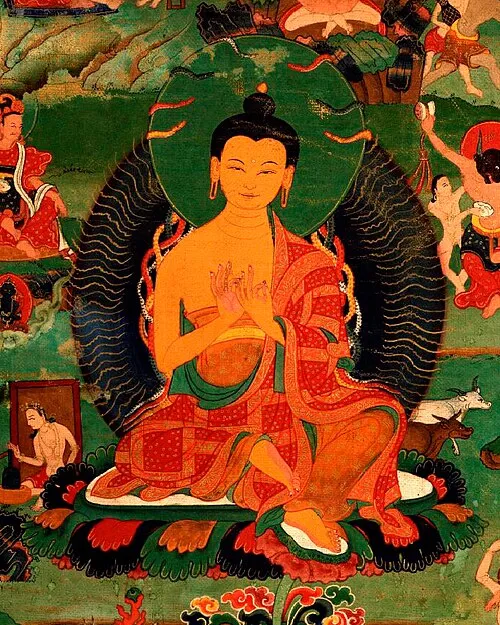
Nagarjuna
c. 150 – c. 250
Nāgārjuna (c. 150–250 CE) is, after the Buddha himself, the most important figure in the entire Mahāyāna tradition[1]. As the founder of the Madhyamaka ("Middle Way") school and the principal expositor of *śūnyatā* (emptiness), his thought structures every later Mahāyāna development: Yogācāra, *tathāgatagarbha*, the Chinese Tiantai and Sānlùn schools, the Tibetan Madhyamaka traditions, and the philosophical underpinnings of Chan and Zen[2].
The historical Nāgārjuna is dated to roughly the second or third century CE, active in southern India under the patronage of a Sātavāhana king (variously identified by modern scholars)[3]. The principal hagiographies preserved by Kumārajīva (4th–5th c.) and by the Tibetan historian Tāranātha (17th c.) describe him as a brahmin from the south who entered the Buddhist saṅgha after a youthful misadventure with magical invisibility, recovered *nāga*-treasured texts from the underwater realm of the serpent kings (hence his name), and composed a vast philosophical and devotional corpus[4].
His authentic philosophical works are concentrated in the *Yukti-corpus* (Reasoning collection): the *Mūlamadhyamakakārikā* (Root Verses on the Middle Way), the *Vigrahavyāvartanī*, the *Śūnyatāsaptati*, the *Yuktiṣaṣṭikā*, and the *Vaidalyaprakaraṇa*[5]. The *Mūlamadhyamakakārikā* opens with a homage to the Buddha "the supreme of teachers" and proceeds in twenty-seven chapters to demonstrate that no phenomenon—motion, fire, the self, time, suffering, the *tathāgata*, *nirvāṇa*—possesses *svabhāva* (intrinsic nature) when subjected to careful analysis[6]. The famous chapter twenty-four states the doctrinal claim most concisely: "Whatever is dependently co-arisen, that is explained to be emptiness; that, being a dependent designation, is itself the middle way."[7] His argument is not that nothing exists, but that everything that exists does so only relationally, through *pratītyasamutpāda* (dependent origination); to grasp emptiness as nothingness is, he says, "like grasping a snake by the wrong end."[8]
Tradition also assigns to Nāgārjuna two further bodies of work: the *Stava-corpus* of devotional hymns to the buddhas and bodhisattvas, and the *Suhṛllekha* (Letter to a Friend), addressed to the Sātavāhana king and preserved in the Tibetan and Chinese canons[9]. The vast *Mahāprajñāpāramitā-śāstra* (*Dà Zhì Dù Lùn*), preserved only in Kumārajīva's Chinese translation, is conventionally attributed to Nāgārjuna but is now widely considered to be a 4th-century Central Asian compilation that functioned as a commentarial encyclopedia for early Chinese Mahāyāna[10].
In the Chan lineage Nāgārjuna is the fourteenth patriarch, the disciple of Kapimala and teacher of Āryadeva[11]. The Chan tradition reads his analysis of emptiness as a direct philosophical exposition of the *prajñāpāramitā* perspective from which Chan's teaching of *no-mind* (*wúxīn*) and *original face* derives. The closing dedication of the *Mūlamadhyamakakārikā*—"I prostrate to Gautama, who, out of compassion, taught the true doctrine that leads to the relinquishment of all views"—has been read by Chan and Zen commentators (notably Dōgen and Hakuin) as a description of the Chan task itself[12].
Names
Disciples of Nagarjuna
Teachers and lineage of Nagarjuna
Teacher / root master:
Teachings
Whatever is dependently co-arisen, that is explained to be emptiness. That, being a dependent designation, is itself the middle way. There does not exist anything that is not dependently arisen. Therefore there does not exist anything that is not empty. Without a foundation in the conventional truth, the significance of the ultimate cannot be taught. Without understanding the significance of the ultimate, liberation is not achieved.
- proverbEmptiness Is the Medicine
If you grasp emptiness as a thing, the medicine becomes a sickness. The Buddha gave emptiness as the medicine for all views; do not let it become another view.
- proverbTwo Truths
There is conventional truth and there is ultimate truth. Without the conventional, the ultimate cannot be taught; without the ultimate, the conventional becomes a prison. Walk on both feet.
- proverbEight Negations
No arising, no ceasing; no permanence, no annihilation; no coming, no going; no one, no many. From this eightfold no, the world arises freshly each instant.
- proverbSnake and Rope
In the dim light, the rope looked like a snake. Once the lamp was brought, neither the snake nor the rope was as you had supposed. Bring the lamp, and your problems re-introduce themselves.
- proverbFriendly Letter to a King
I wrote to a king: rule with patience as if the kingdom were your own body, and not as if your body were the kingdom. The king who confuses these orders ends up wounded by his own taxes.
- proverbWithout a Thesis of My Own
I have no thesis of my own. I take up your thesis, follow it through, and let it dissolve at its own end. Whoever calls me a teacher of nothing has heard me correctly.
Other masters in Indian Patriarchs
Master Record Sources
- datesZen Editorial Overlay - Originals Curation
c. 150-250 CE
- nameZen Editorial Overlay - Originals Curation
Nagarjuna
- schoolZen Editorial Overlay - Originals Curation
Indian Patriarchs
- teachersZen Editorial Overlay - Originals Curation
Kapimala
- identityWikipedia - Zen Lineage Charts
Nāgārjuna (c. 2nd century CE) was the founder of the Madhyamaka school of Mahāyāna Buddhism, author of the Mūlamadhyamakakārikā, and is counted the fourteenth Indian patriarch in Chan/Zen lineage lists.