Gudo Wafu Nishijima
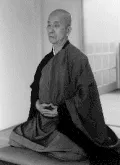
Gudo Wafu Nishijima
1919 – 2014
Gudō Wafu Nishijima (西嶋愚道和夫, 29 November 1919 – 28 January 2014) was a Japanese Sōtō Zen priest, translator, and one of the most consequential modern Japanese teachers of Dōgen for an English-speaking audience[1]. As a young man in the early 1940s he became a student of Kōdō Sawaki — placing him in the same lay-Zen lineage that would also produce Taisen Deshimaru — and after the Second World War he took a law degree from Tokyo University and entered a long career in finance, working at the Japanese Ministry of Finance and later in the securities industry[1]. He did not ordain as a Buddhist priest until 1973, when he was already in his mid-fifties; his preceptor was Niwa Rempō Zenji, the future head abbot of Eihei-ji and a former leader of the Sōtō school. **Four years later, in 1977, Niwa conferred dharma transmission (shihō) on Nishijima**, formally accepting him as one of his successors — the same authority who would in 1984 transmit the dharma to three of Deshimaru's disciples[1]. Nishijima continued his professional career until 1979.
From the 1960s he gave regular public lectures on Buddhism and zazen, and from the 1980s he began lecturing in English and accepting foreign students[1]. His most lasting work is textual: with his English dharma heir Mike Chōdō Cross he produced one of only three complete English translations of Dōgen's ninety-five-fascicle Kana Shōbōgenzō, and he separately translated Dōgen's Shinji Shōbōgenzō (the Mana / "true-character" Shōbōgenzō, a Chinese-language collection of kōans). He also published, with Brad Warner, an English edition of Nāgārjuna's Mūlamadhyamakakārikā[1]. **In 2007, Nishijima and a group of his students organised as Dōgen Sangha International**, a non-monastic global network of Nishijima's lay and ordained successors[1].
His distinctive interpretive scheme, "Three Philosophies and One Reality" (三哲学と一実在), reads Dōgen's texts as a four-perspective structure mapped onto the Four Noble Truths: an idealist/subjective view (dukkha), a materialist/objective view (samudaya), a realist synthesis (nirodha), and the lived reality of the path (magga)[1]. Coupled with his lay-friendly emphasis on the autonomic nervous system as a frame for understanding the effects of zazen, this gave him an unusually wide reach among scientifically- and philosophically-minded Western readers. Among his recognised dharma heirs are Mike Chōdō Cross (UK), Brad Warner (US), Jundo Cohen (Treeleaf Zendo), Jeremy Pearson, Yodō Brian Wickham, and others — a lineage carried forward today as much through Internet sangha and English-language publishing as through traditional residential temples.
Names
Disciples of Gudo Wafu Nishijima
Teachers and lineage of Gudo Wafu Nishijima
Teacher / root master:
Additional teachers:
Other masters in Sōtō
Master Record Sources
1919-2014
Gudo Wafu Nishijima
Soto
Kodo Sawaki
1919-2014
Gudo Wafu Nishijima
Soto
Rempo Niwa