Punyamitra
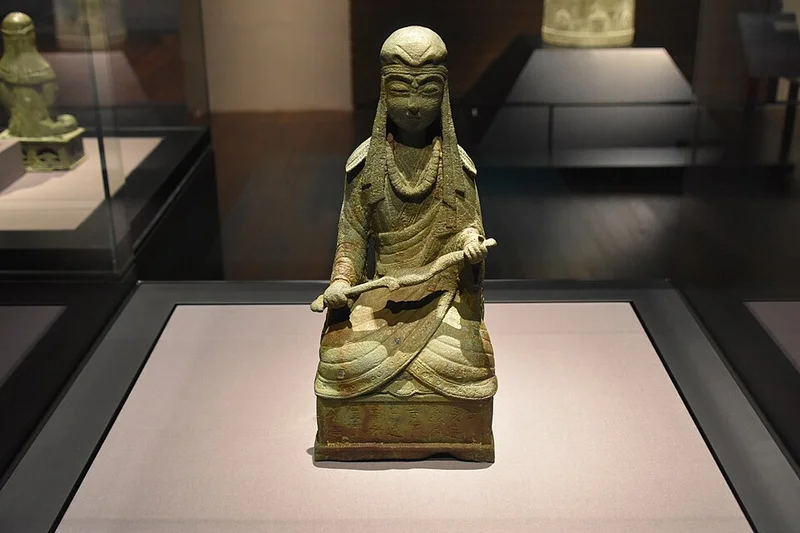
Punyamitra
5th c. – Unknown
Puṇyamitra ("Friend of Merit"), twenty-sixth patriarch in the Chan list, is named in the *Jǐngdé Chuándēng Lù* as the disciple of Vasiṣṭha and the teacher of Prajñātāra, the master of Bodhidharma[1]. Like the other late-Indian figures, he belongs to the legendary stratum of the lineage and is not independently attested.
Dumoulin notes that Puṇyamitra's sole narrative function in the *Jǐngdé Chuándēng Lù* and the *Bǎolín Zhuàn* is the recognition and ordination of Prajñātāra; the placement positions him as the immediate predecessor of the figure who will release the transmission eastward[2].
Names
Disciples of Punyamitra
Teachers and lineage of Punyamitra
Teacher / root master:
Teachings
- dialogueWhy Did You Become a Monk?
Puṇyamitra was said to be of royal birth who renounced his position to seek the Dharma. When Vasiṣṭha asked him upon their first meeting: 'Why did you leave the palace?' Puṇyamitra said: 'I saw that the palace was built on sand, and the sand was built on nothing. I wanted to find what the nothing was built on.' Vasiṣṭha said: 'And have you found it?' Puṇyamitra said: 'I am standing on it.' Keizan's verse: Palace walls rise and fall— / a lifetime of sand-building. / One morning, the question arises: / What holds up the ground itself?
- dialogueThe Third Son's Understanding
Puṇyamitra held up a jewel before three princes and asked each one: 'What is this?' The first said: 'A precious gem.' The second said: 'A gift beyond price.' The third—who would become Prajñātāra—said: 'This is the form of the formless, and the name of the nameless.' Puṇyamitra said: 'The other two answered what it is. You answered what it points to.'
- proverbWalk, Do Not Talk
I walked a long way for this dharma; I do not propose to talk it back into a cage. Whoever wants to know what I know should walk too.
- proverbOld Age Teaches by Itself
Old age teaches by itself if you let it. Do not race against your wrinkles; let them be the third teacher in the room, after your master and your hut.
- proverbDo Not Pity Yourself
Self-pity is the sickness that disguises itself as the cure. Cut it cleanly; you will be surprised how light the body becomes when you are no longer carrying yourself.
Other masters in Indian Patriarchs
Master Record Sources
- datesZen Editorial Overlay - Originals Curation
trad. 5th c. CE
- nameZen Editorial Overlay - Originals Curation
Punyamitra
- schoolZen Editorial Overlay - Originals Curation
Indian Patriarchs
- teachersZen Editorial Overlay - Originals Curation
Vasasita
Puṇyamitra is counted the twenty-sixth Indian patriarch in Chan/Zen lineage reckoning; the Tibetan Buddhist Encyclopedia records the traditional account of his transmission in the late Indian patriarchal succession.