Yangqi line
Chan
Yangqi line
楊岐派
Branch of Linji
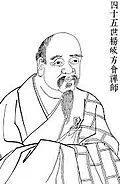
The Yangqi line is the dominant sub-branch of the Linji school, founded by Yangqi Fanghui (992–1049), a student of Shishuang Chuyuan[1]. It emerged alongside the Huanglong branch when the Linji school divided in the Song dynasty, and eventually absorbed and superseded the Huanglong line to become the sole surviving Linji lineage[1]. The Yangqi branch is characterized by an unpredictable, spontaneous teaching style—Yangqi himself was known for playful and surprising responses that kept students off balance[1]. The line produced many of the most important figures in later Chan history: Wuzu Fayan, Yuanwu Keqin (compiler of the Blue Cliff Record)[2], Dahui Zonggao (champion of huatou practice, who famously burned the Blue Cliff Record's printing blocks)[3], and Wumen Huikai (compiler of the Gateless Barrier)[4]. Through Xutang Zhiyu's transmission to Nanpo Jomyo, the Yangqi line became the foundation of virtually all Japanese Rinzai Zen[5]. The Yuan dynasty hermit-poet Shiwu Qinggong (Stonehouse) and the intense practitioner Gaofeng Yuanmiao also belong to this lineage[6].
Meditation practice
The Yangqi line championed huatou meditation, in which the practitioner takes up a single critical phrase and investigates it with total concentration until the questioning itself becomes more important than any verbal answer[3]. Dahui Zonggao promoted this kanhua chan (看話禪, ‘observing the phrase’) as a portable and rigorous practice suitable for monks, officials, and laypeople alike[3]. Practice in this line therefore centers on concentrated inquiry, repeated return to the live point of doubt, and dynamic teacher-student testing. Its teaching style prizes spontaneity and compression, using surprise to keep students from settling into secondhand understanding.
Key texts
- Blue Cliff Record
Yuanwu — the Yangqi-line master at Jiashan — composed the monumental commentary on Xuedou's 100 cases that became the literary summit of Chan. Dahui later burned the printing blocks to break students' attachment to its prose.
- Gateless Barrier
Compiled by a Yangqi-line master for the training of his students — 48 kōans with pointing verses. Lighter and more didactic than the Blue Cliff Record; the standard koan entry text in every subsequent school.
- Letters of Dahui
Dahui's correspondence with scholar-officials and lay practitioners, making the case for huatou meditation against 'dead sitting.' The manifesto that made kanhua chan the dominant Song practice.
Key concepts
- Kanhua chan
'Observing the phrase' Chan — Dahui Zonggao's systematization of huatou meditation. The Yangqi line's signature export, inherited in modified form by Korean Seon and Japanese Rinzai.
- Huanglong / Yangqi split
The mid-Song division of the Linji school into two sub-branches founded by fellow students of Shishuang Chuyuan. Yangqi eventually absorbed Huanglong and became the sole surviving Linji lineage.
In the words of the masters
- Right and Wrong
If you want to know right and wrong, consider your own situation carefully.
- Now Is the Instant
Practice cannot be saved for tomorrow. Even today is too late if you wait until evening. Now is the instant — the only one available.
- Do Not Cling to the Moment
If you cling to this moment, it becomes a moment ago and you have already missed it. Hold it loose enough that the next one finds your hand still open.
- What Has Not Yet Been Spoken
The most important sentence in the dharma has not yet been spoken — and it is being spoken now. The student who waits for the famous sentences will hear only the echoes.
- Iron Mountain Pass
There is an iron mountain pass through which the patriarchs walked. From a distance, the pass looks impossible; up close, the road runs straight through. The fear was the only obstacle.
Masters in this branch
Sibling branches of Linji
Sources in use
- Chart of the Chan Ancestors
- Zen Editorial Overlay - Originals Curation