Roland Rech
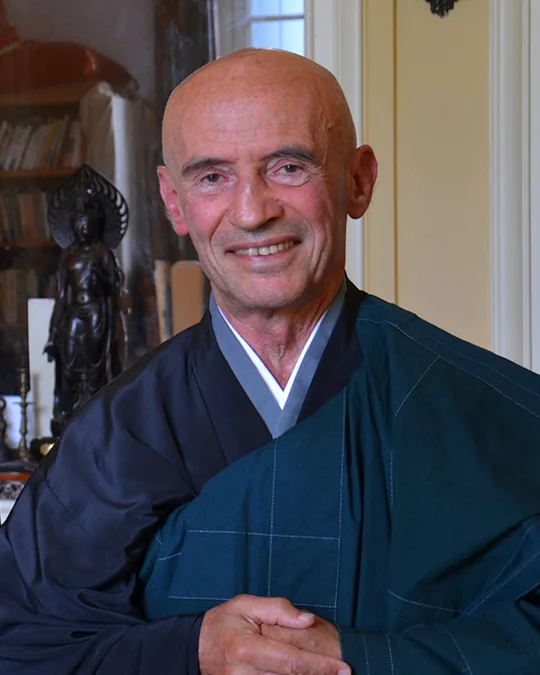
Roland Rech
1944 – 2024
Roland Yuno Rech (born Roland Rech, 20 June 1944, Paris) is one of the most senior and prolific living teachers of European Sōtō Zen[1]. A graduate of Sciences Po (Institut d'études politiques de Paris, promotion 1966) and of the DESS in Clinical Human Sciences at Université Paris VII-Denis-Diderot, he discovered zazen in 1971 at the Sōtō Antaiji temple in Kyoto during a worldwide search for meaning[1][2]. On his return to France in 1972 he became the disciple of Taisen Deshimaru — a relationship that lasted until Deshimaru's death in 1982 — and was ordained as a monk in 1974, while keeping, on Deshimaru's recommendation, his industrial-management career so as to serve as one of his teacher's principal translators, dōjō coordinators, book editors, and sesshin leaders[1][2].
**In 1984, Niwa Rempō Zenji of Eihei-ji conferred dharma transmission (shihō) on Rech together with Étienne Mokushō Zeisler and Stéphane Kōsen Thibaut**, the three of Deshimaru's disciples authenticated by Japan's highest Sōtō authority[1][2]. Rech then took on the dharma name Yuno (有能 — "capable, courageous")[1]. He served as president of the Association Zen Internationale until 1994, was a founding member of the Union Bouddhiste de France in 1986 and its vice-president for fifteen years[1][5], and now teaches at the temple Gyō Butsu-ji in Nice, at La Gendronnière, and across the AZI sesshin circuit[3]. The Sōtōshū Shūmuchō has formally recognised him as dendō kyōshi (伝道教師, missionary monk) for Europe[1][4]; in 2007, his students founded the Association Bouddhiste Zen d'Europe (ABZE), the institutional umbrella under which the Yuno Rech line now operates across France, Germany, Italy, Spain, Belgium, and Switzerland[1][2].
Since 2010, Yuno Rech has himself transmitted shihō to a now-substantial generation of European successors[1][2]. The first cohort comprised Patrick Pargnien (Bordeaux) and Heinz-Jürgen Metzger (Solingen / Cologne) in 2010; Sengyo Van Leuven (Rome Jōhōji) in 2011; Emanuela Dōsan Losi (Carpi) in 2012, his first woman dharma heir; and Pascal-Olivier Kyōsei Reynaud (Narbonne) in 2013, who performed his hossen-shiki ceremony at Gyō Butsu-ji in February of that year[1][2]. Michel Jigen Fabra (Poitiers) followed in 2014 and went directly to Eihei-ji and Sōji-ji for the formal zuise visit required by the Sōtōshū to be confirmed as oshō[1][2][4].
Through the second half of the 2010s the network broadened across borders: Konrad Kōsan Maquestieau (Halle, Belgium) in 2015; Lluís Nansen Salas (Barcelona Kannon), Claude Émon Cannizzo (Mulhouse), Antonio Taishin Arana (Pamplona Genjō), and Alonso Taikai Ufano (Sevilla) in March and December 2016 — a sweep that anchored the Iberian peninsula in the Yuno Rech line for the first time[1][2]. Antoine Charlot (Bondy) and Marc Chigen Estéban (Chalon-sur-Saône, current ABZE president) followed in 2018, and Beppe Mokuza Signoritti (Alba) and Eveline Kogen Pascual (Aachen) in 2019, deepening the Italian and German wings respectively[1][2].
A second wave from 2022 onward has continued the pattern: Huguette Moku Myō Siréjol (Toulouse) and Jean-Pierre Reiseki Romain (Dōjō Zen de Paris) in 2022 — Romain himself a 1981 disciple of Deshimaru ordained by Philippe Coupey — were followed by Sergio Gyō Hō Gurevich (Paris-Tolbiac) and Luc Sojō Bordes (Vernon) in 2023, and most recently by Silvia Hoju Leyer (Aachen) and Claus Heiki Bockbreder (Melle / Osnabrück) in 2024[1][2]. Together this cohort of more than twenty successors makes Yuno Rech, by the mid-2020s, the most institutionally productive of Deshimaru's three direct heirs and the principal vector through which the AZI line is reproducing itself in the second European generation[1][2][3].
He is the author of numerous books in French on Dōgen's Shōbōgenzō, the Sandōkai, and the practice of zazen, drawing his characteristic kusen-style oral teaching directly from Dōgen's text; his commentary on the Genjōkōan, *La realización del despertar* (translated into Spanish by Antonio Arana and Txus Laita), has circulated widely in the Iberian sangha[2][6]. His public role and prolific publishing have made him, in the years since Deshimaru's death, the most institutionally visible of Deshimaru's heirs and one of the principal European interpreters of Dōgen's philosophy[1][3][5].
Names
Disciples of Roland Rech
- Patrick Pargnien
- Heinz-Jurgen Metzger
- Sengyo Van Leuven
- Emanuela Dosan Losi
- Pascal-Olivier Kyosei Reynaud
- Michel Jigen Fabra
- Konrad Kosan Maquestieau
- Lluis Nansen Salas
- Claude Emon Cannizzo
- Antonio Taishin Arana
- Alonso Taikai Ufano
- Antoine Charlot
- Marc Chigen Esteban
- Eveline Kogen Pascual
- Beppe Mokuza Signoritti
- Huguette Moku Myo Sirejol
- Jean-Pierre Reiseki Romain
- Sergio Gyo Ho Gurevich
- Luc Sojo Bordes
- Silvia Hoju Leyer
- Claus Heiki Bockbreder
Teachers and lineage of Roland Rech
Teacher / root master:
Formal Dharma transmission (shihō):
Works
- Institutional siteAssociation Bouddhiste Zen d'Europe (ABZE) — abzen.eu
The European Buddhist Zen Association founded by Roland Yuno Rech as the umbrella organisation for the dōjōs in his branch of the AZI federation; carries his teisho archive and the network's calendar.
Teachings
- proverbLetting Go Is Not Giving Up
Letting go is not giving up. It is opening your hands and letting life be what it is.
- proverbZazen Is a Mirror
Zazen is like a mirror that reflects everything without judgment. In this mirror, you can see yourself as you truly are.
In zazen, body and mind are not separate. When you straighten the spine, you straighten the mind. When you let the breath settle naturally, the thoughts settle naturally. This is why Dogen placed such emphasis on the posture—not as a physical exercise, but as the concrete expression of awakening. The body sitting in zazen is not the container of the mind; it is the mind itself, made visible. To sit with the correct posture, in complete presence, is to realize the unity of body and mind that we call Buddha.
The practice of zazen is very simple: always returning to the present moment. When you notice that you have been carried away by your thoughts, you come back to the posture, the breathing, the present reality. This return is not a failure—it is the practice itself. Each time you return, you are practicing the fundamental gesture of awakening: letting go of illusion and coming back to what is real.
Other masters in Sōtō
Master Record Sources
1944-2024
Roland Rech
Soto
Taisen Deshimaru