About Zen
Introduction
What is Zen Lineage?
An open source encyclopedia of Chan and Zen history
Where to begin
Three doors into the encyclopedia
What is Zen?
Zen is the practice of sitting down and looking directly at what you are. No scripture can do it for you, no concept can replace it.
One word, five languages
Zen, Chán, Seon, Thiền, dhyāna — these are the same word, refracted across the languages the tradition travelled through. The Sanskrit dhyāna (ध्यान, “meditative absorption”) was transliterated into Chinese as chánnà (禪那), shortened to chán (禪), and then read in Korean as Seon (선/禪), in Vietnamese as Thiền, and in Japanese as Zen (禅). The English word “Zen” is the Japanese reading, which is why the English-speaking world tends to assume the tradition is Japanese when it is, in fact, Chinese in origin and pan-Asian in scope (Dumoulin, Zen Buddhism: A History, Vol. 1, 2005, pp. 9–13).
One tradition, four schools, four names
Chán, Seon, Thiền, and Zen are the same tradition as it took root in China, Korea, Vietnam, and Japan. The doctrinal core is identical: direct pointing at the mind, transmission outside the scriptures, awakening as recognition of one’s own nature. What diverges is style. Chinese Chán kept its Tang-dynasty diversity longest. Korean Seon centred on hwadu investigation under Jinul. Vietnamese Thiền produced the indigenous Trúc Lâm school in 1299 and, in our own time, Thích Nhất Hạnh’s engaged-Buddhism reformulation. Japanese Zen split into the kōan-driven Rinzai and the silent-illumination Sōtō, and is the form that travelled to the West first. Treating any one of these as the “real” Zen and the others as variants is a category error.
Meditation, transmission, awakening
Three things hold the tradition together across all four regional forms. The first is meditation — zazen in Japanese, ordinary seated practice with a straight back and a bare attention to what is. Sōtō calls it shikantaza (“just sitting”); Rinzai pairs it with kōan introspection; Korean Seon uses hwadu; the underlying act is the same. The second is transmission — not a doctrine passed in books but a relationship between teacher and student, ratified when the teacher recognises in the student what the teacher’s own teacher recognised in them. Modern scholarship has shown the lineage charts to be partly retrospective constructions (Welter, The Linji Lu, 2008, pp. 29–55), but the principle — that awakening is verified, not self-declared — remains the spine of the institution. The third is awakening itself: kenshō (見性, “seeing one’s nature”), the moment the practitioner recognises that the buddha-nature being sought has been the one looking the whole time.
Etymology
The word Zen (禅) is the Japanese reading of the Chinese character Chán (禪), itself a transliteration of the Sanskrit dhyāna (ध्यान), meaning “meditative absorption” or “meditative state.” The term entered Chinese Buddhism through early translations of Indian meditation texts. Long before Chan emerged as a distinct school, Chinese Buddhists were already translating and practicing forms of dhyāna; Bodhidharma later became the emblematic first patriarch of Chan in the tradition’s lineage accounts[1]. In Korean the tradition is called Seon (선/禪), and in Vietnamese, Thiền.

Definition
Zen is a school of Mahāyāna Buddhism that originated in China during the Tang dynasty (618–907 CE) and subsequently spread to Korea, Japan, and Vietnam. It emphasises meditation practice (zuòchán / zazen) and direct, experiential insight into one’s own nature (jiànxìng 見性, Japanese kenshō) as the primary path to awakening, rather than sole reliance on doctrinal study or ritual observance[2].
A celebrated four-line verse, traditionally attributed toBodhidharma but likely compiled in the late Tang period, captures the school’s self-understanding[3]:
A special transmission outside the scriptures,
Not dependent on words and letters;
Pointing directly at the human mind,
Seeing into one’s nature and attaining Buddhahood.
As John McRae notes, these lines “should not be understood as a historically accurate description of Chan’s origins, but as a retrospective distillation of its identity”[4]. Zen has always been embedded in the broader Mahāyāna tradition: its monasteries follow the Vinaya, its liturgy draws on sutras, and its doctrinal vocabulary is shaped by Madhyamaka and Yogācāra philosophy[5].
Core Practice: Zazen
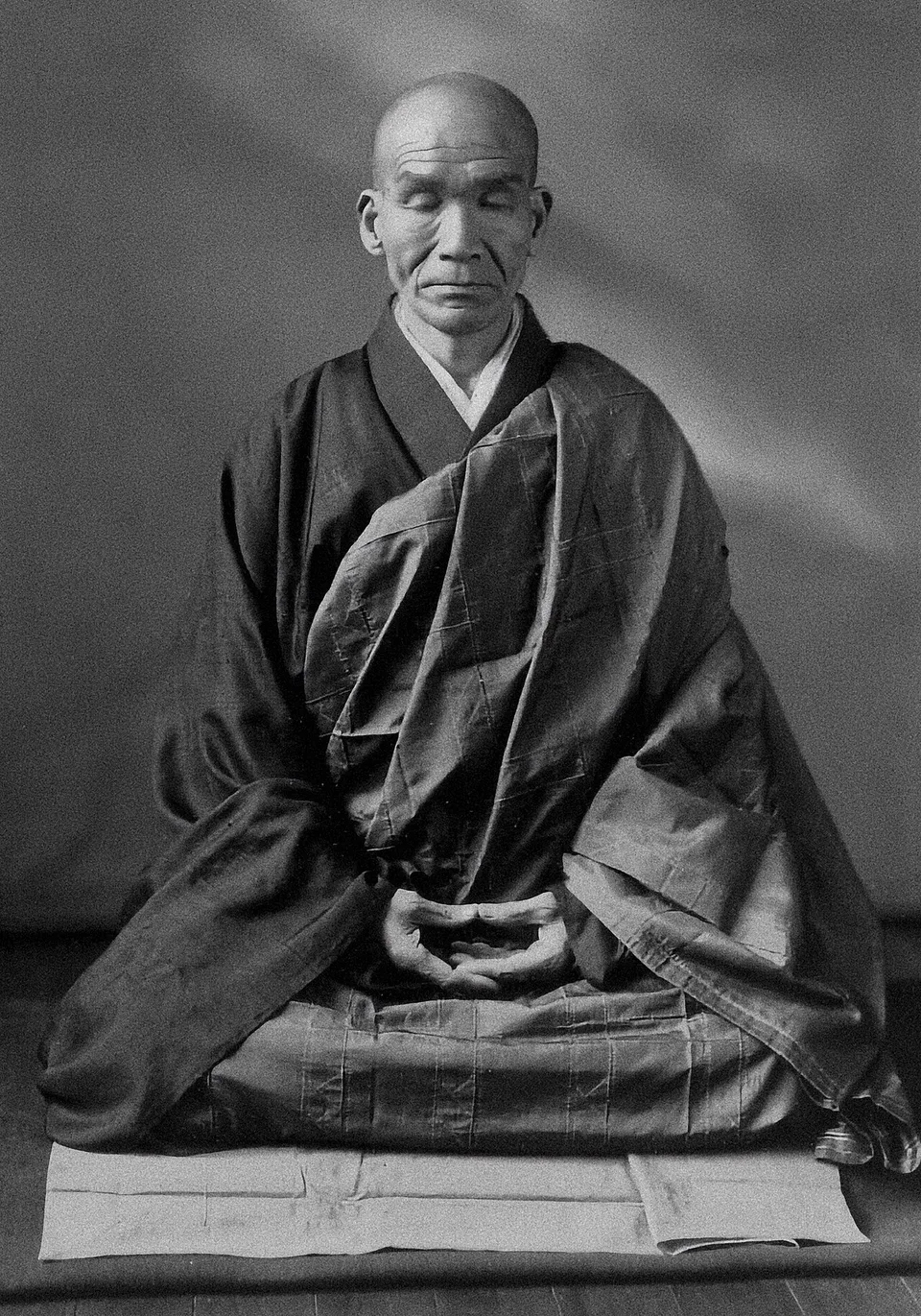
The central practice of Zen is seated meditation, known as zazen (坐禅, “sitting dhyāna”). In the Sōtō school, this takes the form of shikantaza(“just sitting”), a practice of objectless awareness in which the practitioner sits upright, following the breath without pursuing or suppressing thoughts. Dōgen Zenji (1200–1253) described this in his Fukanzazengi(“Universal Recommendations for Zazen”): “Think of not-thinking. How do you think of not-thinking? Non-thinking. This in itself is the essential art of zazen” (Dōgen, tr. Tanahashi, Treasury of the True Dharma Eye, 2010, p. 886).
In the Rinzai (Linji) school, zazen is complemented by intensive engagement with kōan (公案) — paradoxical questions or dialogues drawn from the records of past masters. The practitioner holds the kōan in mind during meditation and in all daily activities, working to penetrate its meaning beyond conceptual thought. The classic kōan “What is the sound of one hand?” was formulated by Hakuin Ekaku (1686–1769), who systematised kōan practice into a structured curriculum[6].

Key Concepts
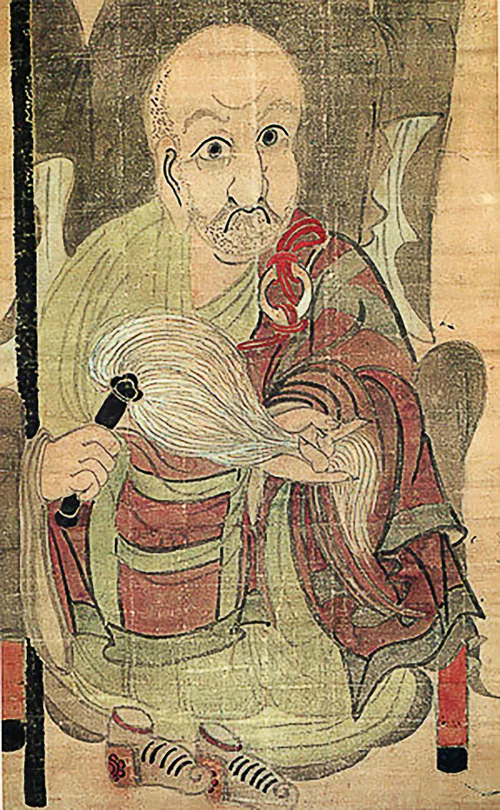
Buddha-nature (foxìng 佛性) — Zen inherits from the Tathāgatagarbha doctrine the assertion that all sentient beings possess the potential for awakening. The Platform Sutra, attributed to the Sixth Patriarch Huìnéng (638–713), states: “Good friends, the bodhi-nature is originally pure. By making use of this mind, one directly attains Buddhahood” (Yampolsky, The Platform Sutra of the Sixth Patriarch, 1967, p. 130).
Sudden and gradual awakening — The dialectic between sudden (dùn 頓) and gradual (jiàn 漸) enlightenment has shaped Zen since the traditional account of the rift between Huìnéng and Shénxiù (606?–706). Modern scholarship has shown that this distinction was more polemical than practical: most Chan masters acknowledged both instantaneous insight and sustained cultivation (Gregory, Sudden and Gradual: Approaches to Enlightenment in Chinese Thought, 1987, pp. 1–35).
Emptiness (śūnyatā, kōng 空) — Following the Prajñāpāramitā literature andNāgārjuna’s Mūlamadhyamakakārikā, Zen holds that all phenomena are empty of independent, inherent existence. This is not nihilism but the recognition that things arise interdependently. The Heart Sutra, chanted daily in Zen monasteries, declares: “Form is emptiness; emptiness is form” (Red Pine, The Heart Sutra, 2004, pp. 2–3).
Transmission (yìxīn chuánxīn, “mind-to-mind transmission”) — Zen maintains an unbroken lineage of teacher-to-student dharma transmission stretching from Śākyamuni Buddha through the Indian patriarchs toBodhidharma and his Chinese successors. While modern historians recognise that portions of these lineage records were retrospectively constructed (Welter, The Linji Lu and the Creation of Chan Orthodoxy, 2008, pp. 29–55), the lineage principle remains central to Zen’s institutional authority and its emphasis on the living relationship between teacher and student.
Historical Development
Zen’s lineage stretches from fifth-century India, through Tang-dynasty China, and onward into Korea (as Seon), Japan (as Zen), Vietnam (as Thiền), and — over the past century — the rest of the world. The tradition frames itself as a mind-to-mind transmission running from the historical Buddha through twenty-eight Indian patriarchs, the six patriarchs of early Chinese Chan, the Five Houses of the late Tang, and the national branches that followed.
The full chronological account — Bodhidharma’s arrival, the Tang masters, the Song-dynasty kōan collections, the transmission to Japan, the twentieth-century opening to the West — lives on the Timeline page. This page is the what and the why; the Timeline is the when.
Transmission to the West
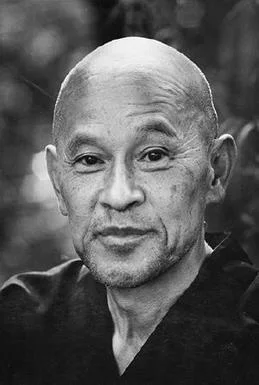
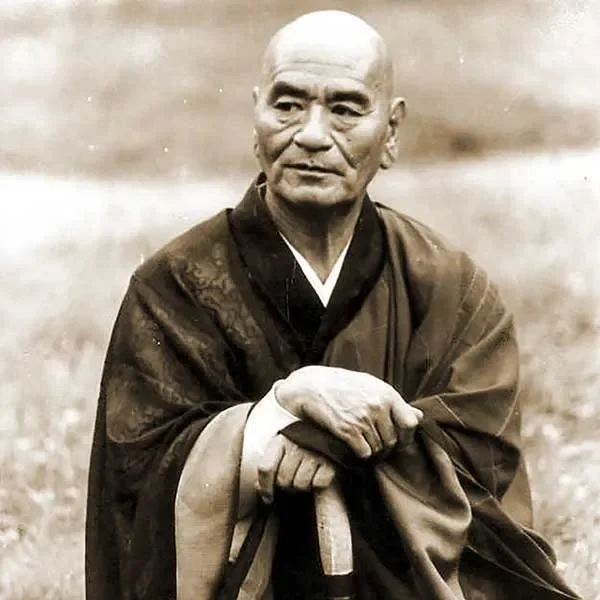
The twentieth-century opening took two parallel paths. In the United States, Shunryū Suzuki (1904–1971) founded San Francisco Zen Center in 1962, planting Sōtō practice on American soil and shaping a generation of Western teachers through Zen Mind, Beginner’s Mind. In Europe, Taisen Deshimaru (1914–1982) arrived in Paris in 1967 and established the Association Zen Internationale, around which most of European Sōtō Zen still organises itself today. Vietnamese Thiền reached the West through Thích Nhất Hạnh (1926–2022), who founded Plum Village in the Dordogne in 1982 and reformulated practice as “engaged Buddhism” — the same zazen, recast as mindful daily action in the world.
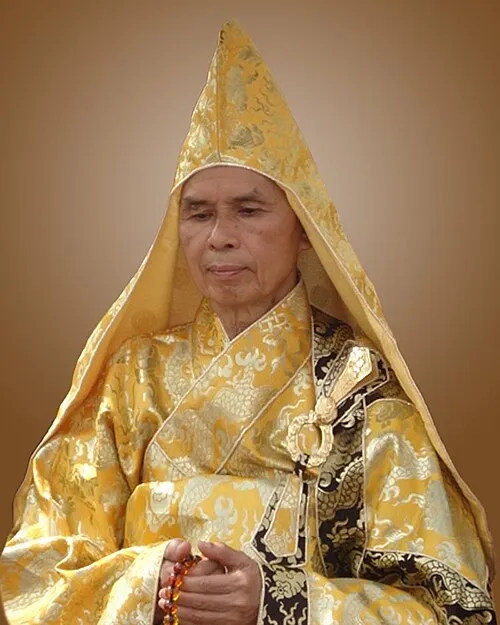
The Major Schools
Five major Chan lineages emerged during the late Tang and Five Dynasties period, of which two survived to the present day (Leighton, Zen’s Chinese Heritage, 2000, pp. 3–7):
The three extinct Tang-dynasty houses — Guiyang (潙仰), Yunmen (雲門), and Fayan (法眼) — were absorbed into the Linji lineage during the Song dynasty, though their distinctive teaching styles are preserved in the kōan literature.
The Ensō
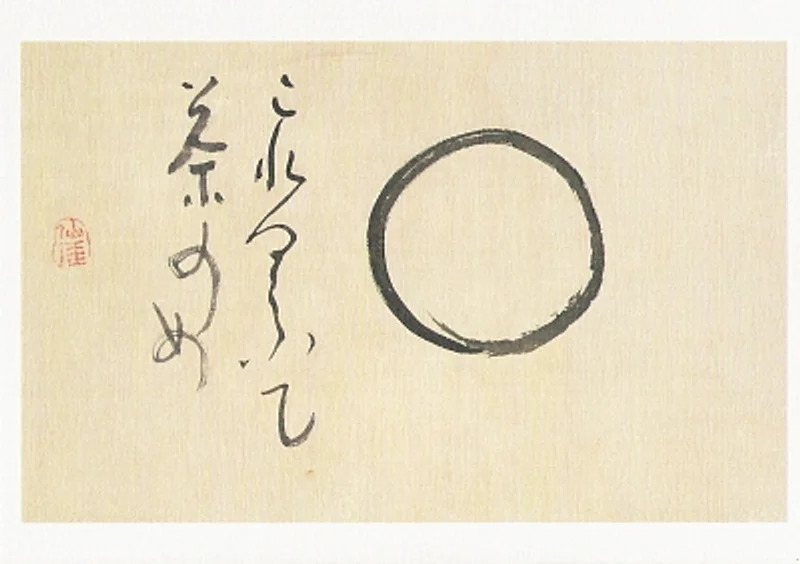
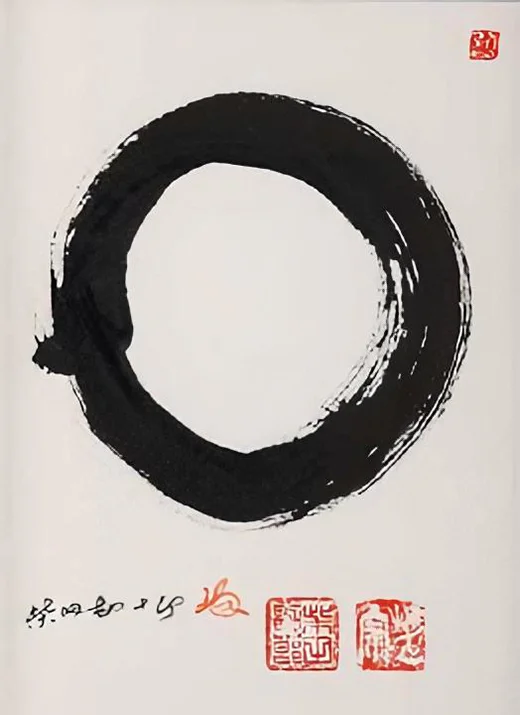
An ensō (円相) is a circle drawn in a single brushstroke. It is one of the most recognisable symbols of Zen, expressing wholeness, the void (śūnyatā), and the beauty of imperfection. The practice of painting ensō belongs to the broader tradition of Zen calligraphy (bokuseki, “ink traces”), in which the spontaneous gesture of the brush is understood to reveal the state of mind of the practitioner at the moment of execution (Addiss, The Art of Zen, 1989, pp. 29–34).
Bibliography
- Monograph
Addiss, Stephen. The Art of Zen: Paintings and Calligraphy by Japanese Monks 1600–1925. New York: Harry N. Abrams, 1989.
- Monograph
Aitken, Robert. The Gateless Barrier: The Wu-Men Kuan (Mumonkan). San Francisco: North Point Press, 1991.
- Monograph
Broughton, Jeffrey L. The Bodhidharma Anthology: The Earliest Records of Zen. Berkeley: University of California Press, 1999.
- Biography
Chadwick, David. Crooked Cucumber: The Life and Zen Teaching of Shunryu Suzuki. New York: Broadway Books, 1999.
- Translation
Cleary, Thomas, and J.C. Cleary, trans. The Blue Cliff Record. Boston: Shambhala, 1977.
- Biography
de Coulon, Jacques. Maître Deshimaru: Biographie. Paris: Éditions du Relié, 2009.
- Translation
Dōgen Zenji. Treasury of the True Dharma Eye: Zen Master Dōgen’s Shōbōgenzō. Edited by Kazuaki Tanahashi. Boston: Shambhala, 2010.
- Monograph
Dumoulin, Heinrich. Zen Buddhism: A History. Vol. 1, India and China. Translated by James W. Heisig and Paul Knitter. Bloomington: World Wisdom, 2005.
- Monograph
Dumoulin, Heinrich. Zen Buddhism: A History. Vol. 2, Japan. Translated by James W. Heisig and Paul Knitter. Bloomington: World Wisdom, 2005.
- Monograph
Faure, Bernard. The Rhetoric of Immediacy: A Cultural Critique of Chan/Zen Buddhism. Princeton: Princeton University Press, 1991.
- Edited volume
Gregory, Peter N., ed. Sudden and Gradual: Approaches to Enlightenment in Chinese Thought. Honolulu: University of Hawai’i Press, 1987.
- Chapter
Mohr, Michel. “Hakuin’s Daruma: Negotiating Zen, Art and Iconography.” In Steven Heine and Dale S. Wright, eds., The Kōan: Texts and Contexts in Zen Buddhism. Oxford: Oxford University Press, 2000, pp. 84–109.
- Monograph
Leighton, Taigen Dan. Zen’s Chinese Heritage: The Masters and Their Teachings. Boston: Wisdom Publications, 2000.
- Monograph
McRae, John R. Seeing Through Zen: Encounter, Transformation, and Genealogy in Chinese Chan Buddhism. Berkeley: University of California Press, 2003.
- Monograph
Poceski, Mario. Ordinary Mind as the Way: The Hongzhou School and the Growth of Chan Buddhism. Oxford: Oxford University Press, 2007.
- Translation
Red Pine (Bill Porter). The Heart Sutra: The Womb of Buddhas. Washington, DC: Shoemaker & Hoard, 2004.
- Chapter
Sharf, Robert H. “The Zen of Japanese Nationalism.” In Donald S. Lopez Jr., ed., Curators of the Buddha: The Study of Buddhism Under Colonialism. Chicago: University of Chicago Press, 1995, pp. 107–160.
- Monograph
Suzuki, Shunryū. Zen Mind, Beginner’s Mind. Edited by Trudy Dixon. New York: Weatherhill, 1970.
- Monograph
Welter, Albert. The Linji Lu and the Creation of Chan Orthodoxy: The Development of Chan’s Records of Sayings Literature. Oxford: Oxford University Press, 2008.
- Translation
Yampolsky, Philip B. The Platform Sutra of the Sixth Patriarch. New York: Columbia University Press, 1967.